
Airsoft bounding overwatch: you cover, I move
Airsoft bounding overwatch explained: pick a movement technique by probability of contact, run successive vs alternating bounds, and turn it into fire and movement.
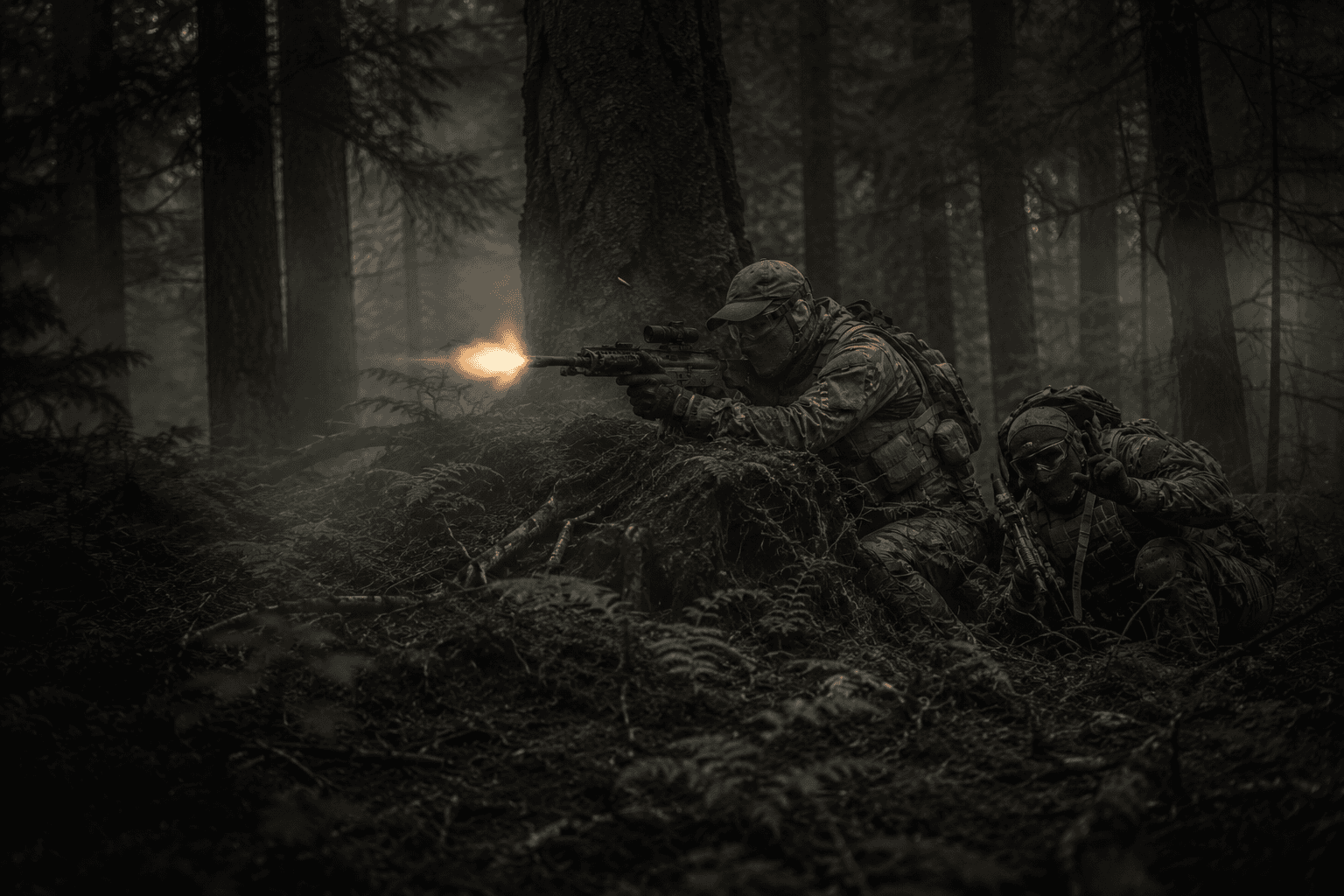
Safe woodland advance has a sound to it: a burst of fire, the rustle of someone moving, silence, then a voice — “set.” That rhythm is bounding overwatch, the “you cover, I move” technique at the centre of squad tactics. Get it wrong and your whole team is caught in the open at once. Get it right and someone is always covering the ground the next man is about to cross.
The three movement techniques
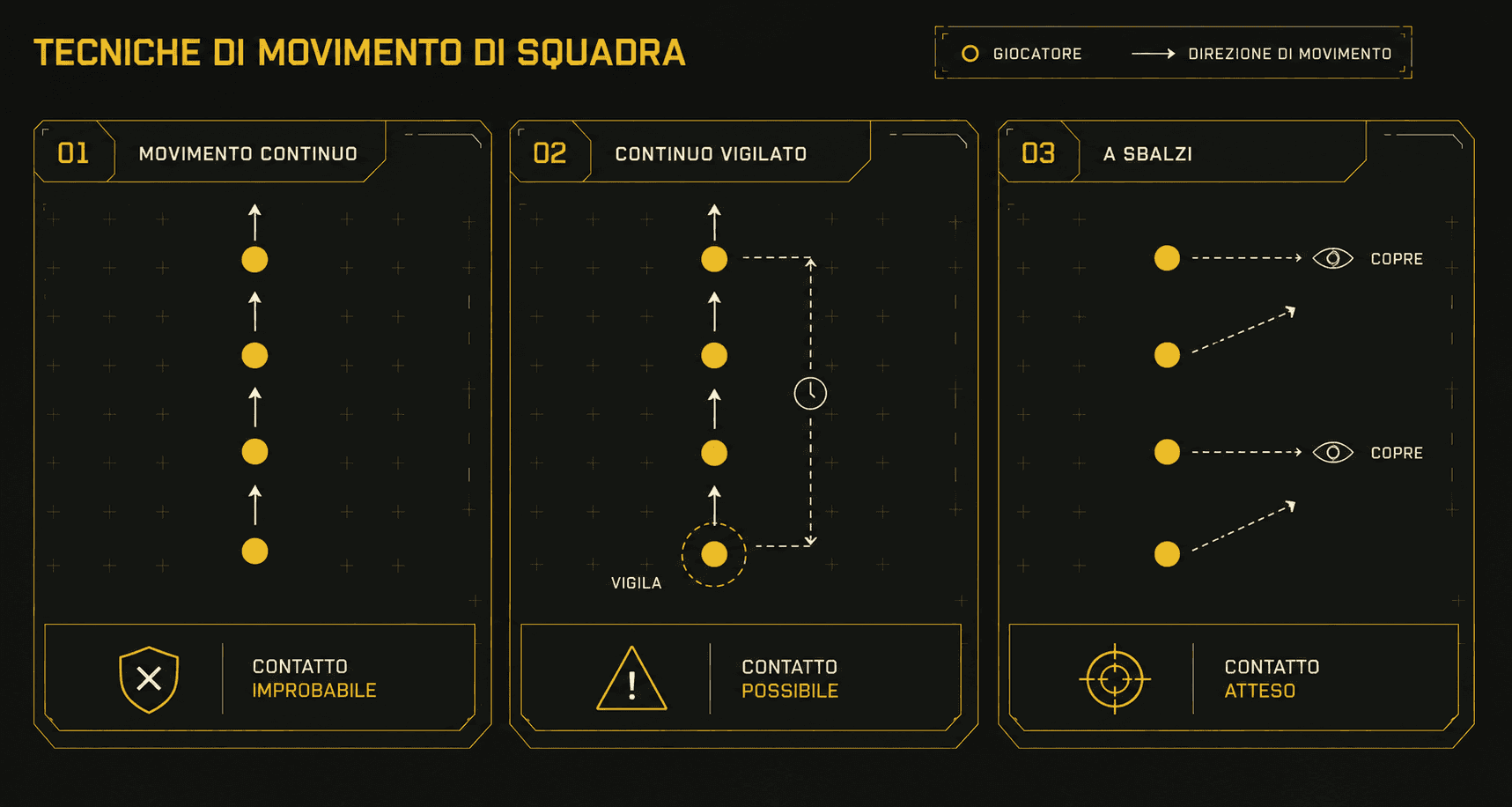
A formation is how your squad is arranged in space — relatively fixed (see our guide to airsoft squad formations). A movement technique describes how the sub-teams are positioned relative to each other, and unlike the formation it changes as you advance, driven by one question: how likely is contact right now? Military doctrine (FM 3-21.8) gives three answers, and they translate cleanly to woodland airsoft.
| Technique | When to use it | Control | Speed | Security |
|---|---|---|---|---|
| Traveling | Contact unlikely | Higher | Fastest | Lowest |
| Traveling overwatch | Contact possible | Medium | Medium | Higher |
| Bounding overwatch | Contact expected | Highest | Slowest | Highest |
Traveling and traveling overwatch
Traveling is the simplest: everyone moves at the same time, at a moderate pace, all alert. You use it to cover distance when contact is unlikely — crossing your own rear ground, moving up a safe lane between objectives.
Traveling overwatch is the middle gear. The lead element moves continuously; the rear element moves at a variable pace, sometimes halting to watch over (overwatch) the lead’s advance. The idea is distance: keep enough of a gap that if the lead walks into contact, the rear is out of contact but positioned to maneuver. Use it when contact is possible but not expected.
Bounding overwatch is the subject of the rest of this article: one sub-team bounds while the other covers, ready to swap roles. You use it when contact is expected. The leader does not pick one technique for the whole route — the technique shifts during the advance as the squad closes on the enemy.
Bounding overwatch: the three states
Bounding overwatch is the core technique of squad woodland combat — the “walk, have cover, the teammate covers” instinct in its doctrinal form. One sub-team bounds (moves) while the other overwatches (covers), both ready to reverse roles.
At any given moment, each sub-team is in one of three states:
- Bounding — in movement, crossing ground toward the next position.
- Overwatching — covering: stationary, scanning enemy positions, replica up and ready to fire.
- Awaiting orders — set, in position, waiting for the leader’s next call.
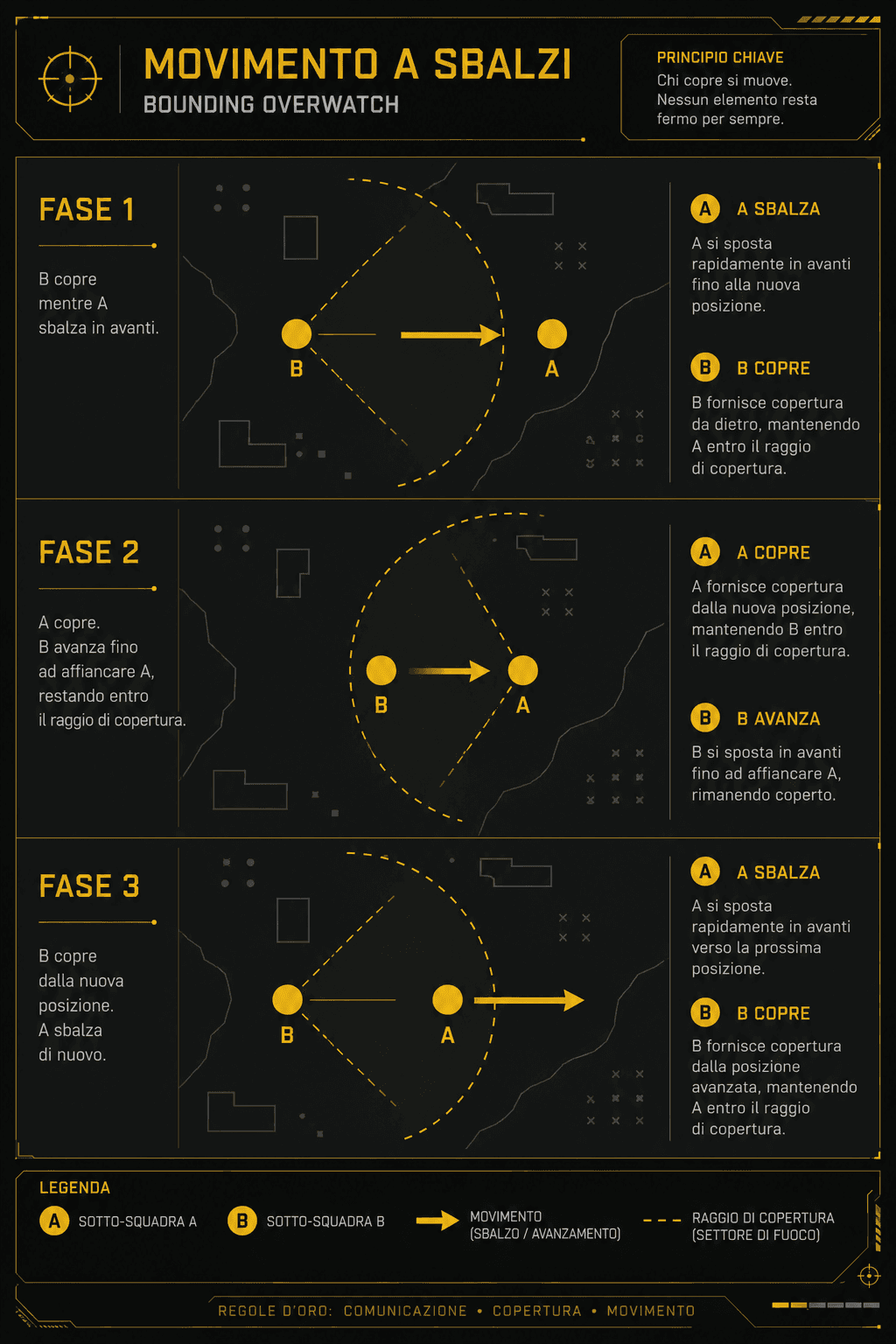
The key to the whole technique is correct use of terrain. The overwatching sub-team must occupy a position with good observation and a clear field of fire over the area the other team is about to bound across — and that position needs real protection, not just leafy screening, so revise the difference between cover and concealmentbefore you pick it. Overwatch from a spot where you can’t actually see or shoot the bound is not overwatch — it’s just two teams standing in the woods.
Successive vs alternating bounds
There are two methods, and the difference is simply who leads after each bound.
Successive bounds — same lead
The lead element is always the same team.
- The lead team, covered by the rear team, advances and occupies a fire support position.
- The rear team advances until it is level (abreast) with the lead team, and halts.
- The lead team advances again. Repeat.
Rule: only one team moves at a time, and the rear team never passes the lead. Characteristic: easier to control — good for thick woodland and poor visibility, where keeping track of who is where matters more than speed.
Alternating bounds — leapfrogging
The lead element changes on every bound.
- Covered by the rear team, the lead team advances, halts, and assumes an overwatch position.
- The rear team advances, passing the lead team, and assumes overwatch ahead of it.
- The team that was leading advances, passing the other. Repeat.
Rule: still only one team moves at a time. Characteristic: normally faster than successive bounds — good for more open terrain where you can see far enough to leapfrog safely. The same bound-and-cover logic shrinks down indoors, where a room-to-room CQB stack is essentially bounding overwatch at arm’s length.
How long is a bound?
Never bound further than the distance at which the covering team can effectively suppress an enemy position. In very close terrain, bounds are shorter. The doctrinal limit is the covering element’s weapons; the airsoft limit is the same idea with a different number:
A bound can never be longer than the effective range of the covering player’s replica. If your covering pair is running AEGs that put BBs on a man-sized target out to roughly 40 metres, then 40 metres is your absolute ceiling for a bound — and you want to be well inside it, because the edge of effective range is where suppression gets thin and unreliable. Bound 25–30 metres, not 50, and you will always be moving inside a cone of fire that actually keeps the enemy’s head down.
This is the single most common mistake new squads make: they bound by terrain (“to that tree”) instead of by reach (“as far as my cover can still hit”). If the next good piece of cover is 60 metres away and your covering replica dies at 40, the bound is too long — break it into two, or find an intermediate position.
What the leader calls before each bound
From the overwatch position, before ordering the other team to bound, the leader passes a short, fixed set of information (FM 3-21.8). On an airsoft field this is a single radio transmission, and it should be a habit:
- The direction or position of the enemy, if known.
- The position of the covering element — where the fire is coming from.
- The next overwatch position the bounding team is moving to.
- The route of the bound.
- What to do once they arrive there.
- Which signal the bounding team will use to report “I’m set, you can cover / you can come.”
- How they will receive the next set of orders.
That looks like a lot for one transmission, and in a textbook it is. In practice, most of it is pre-agreed in the briefing — the route, the signal word, the order-of-march — so the live call collapses to something like: “Bravo, enemy treeline twelve o’clock, bound to the fallen log, I’ve got you, set on ‘Bravo set.’” Brevity discipline matters here; if your callsign and bound vocabulary are sloppy this whole handshake falls apart. (We cover the radio side of it in the radio brevity & callsigns guide.)
Fire & movement: when contact starts
Bounding overwatch happens before contact — nobody is shooting yet, you are simply advancing carefully. The moment real contact begins, the same “you cover, I move” logic becomes fire & movement — the rehearsed battle drill every squad runs on contact, and the same logic in reverse when you break contact.
Once contact starts, the squad splits into two roles:
- The fire (support) element shoots at the enemy and suppresses him — forces him down and stops him from returning aimed fire at the moving teammate.
- The moving (assault) element repositions, either to close with the enemy or to reach a better firing position.
The golden rules
- The moving element does NOT move until the fire element is shooting. Fire first, then the step. A bound that starts before the covering fire is just an exposed player.
- Fire and movement happen simultaneously. While one element is shooting, the other is crossing ground — at the same time, not in turns with a gap between them.
- The moving element never exceeds the fire element’s support distance. When it is about to outrun that distance, it first halts at a position from which it can shoot — and then the roles invert: the team that was moving becomes the team that covers, and vice versa.
- Someone is always shooting. Both pairs never advance together. Move in short bounds (3–5 seconds), or a high or low crawl, depending on terrain and the volume of enemy fire.
Suppression without casualties
Fire & movement rests entirely on suppression, and the obvious objection is that in airsoft nobody gets hurt — so how can you suppress anyone? The answer is that suppression was never really about casualties; it was always about behaviour.
A player under a steady volume of BBs ducks down, loses his line of sight, and stops shooting aimed fire. He cannot pick a target through a stream of pellets cracking off the cover in front of his face — and even if no hit ever lands, he flinches, he breaks his sight picture, he waits for it to stop. That hesitation is the whole point. It gives your teammate the seconds to bound forward.
Two things make airsoft suppression work in practice. Cadence: the covering pair fires at a sustained, steady rate, not one burst and a long pause. A gap in the fire is an invitation for the defender’s head to come back up. Volume: two replicas covering is far more convincing than one — overlapping streams of BBs are almost impossible to peek through. The moving pair runs short, cover to cover, and the instant they are set, the fire shifts to them and the other pair moves. Never do both pairs advance together — someone is always shooting.
Every link in this chain is a piece of communication. The covering pair has to know the exact instant the moving pair is set, or they either stop firing too early (exposing the move) or waste ammo firing at an enemy who is no longer being bounded on. Across thirty metres of woodland, shouting “set” is unreliable and tells the enemy as much as it tells your team. This is where Tattica Six earns its place in the kit: push-to-talk voice carries the “moving” / “set” handshake instantly and privately across any distance, and the live GPS map shows the covering pair exactly where the bounding pair is in real time — so the moment they reach the next position is visible, not guessed. The briefing module lets you pre-load the order of march, the bound-by-bound route and the signal words before the game even starts, which is exactly the pre-agreement the leader’s call depends on. The technique is old doctrine; the app just makes the handshake instant.
FAQ
What is bounding overwatch in airsoft?
Bounding overwatch is a movement technique where one element moves (bounds) while the other holds a position with eyes and replica forward (overwatch), ready to cover. Only one element moves at a time, the bound is never longer than the covering replica’s effective range, and the moving element signals when it’s set so the roles can swap. It’s the safest woodland technique and the one you use when contact is expected.
What is the difference between successive and alternating bounds?
With successive bounds the lead element is always the same: it advances, the rear element moves up level with it but never passes it, and the lead advances again. With alternating bounds (leapfrogging) the lead changes every bound: the rear element advances past the lead and becomes the new front. Successive bounds are easier to control and suit thick woodland; alternating bounds are faster and suit more open terrain.
How does suppression work in airsoft if no one gets hurt?
Suppression in airsoft is psychological, not physical. A player under a steady volume of BBs ducks behind cover, loses line of sight and stops shooting aimed fire — exactly the effect real suppression produces. That break in their fire buys your teammate the seconds to bound forward. The covering element fires at a sustained cadence, not a single burst, so the defender stays down until the move is finished.
What is the difference between movement and maneuver?
Movement is repositioning when you are not in contact — bounding overwatch happens before anyone is shooting. Maneuver begins the moment the squad makes contact with the enemy: it is fire & movement, the moving element advancing under the cover of the firing element. Same “you cover, I move” logic, but now live rounds are in the air and the rule is absolute — the moving element does not move until the fire element is shooting.
Coordinate your next game with Tattica Six
Live GPS map, push-to-talk and shared briefing — for the squad that takes airsoft seriously.
Explore Tattica Six