
CQB room clearing for airsoft: stack, slice, dominate
Stack formations, slicing the pie, hook vs button-hook vs criss-cross entries, points of domination and threshold management — translated for airsoft realities like BB ricochet and no suppression.
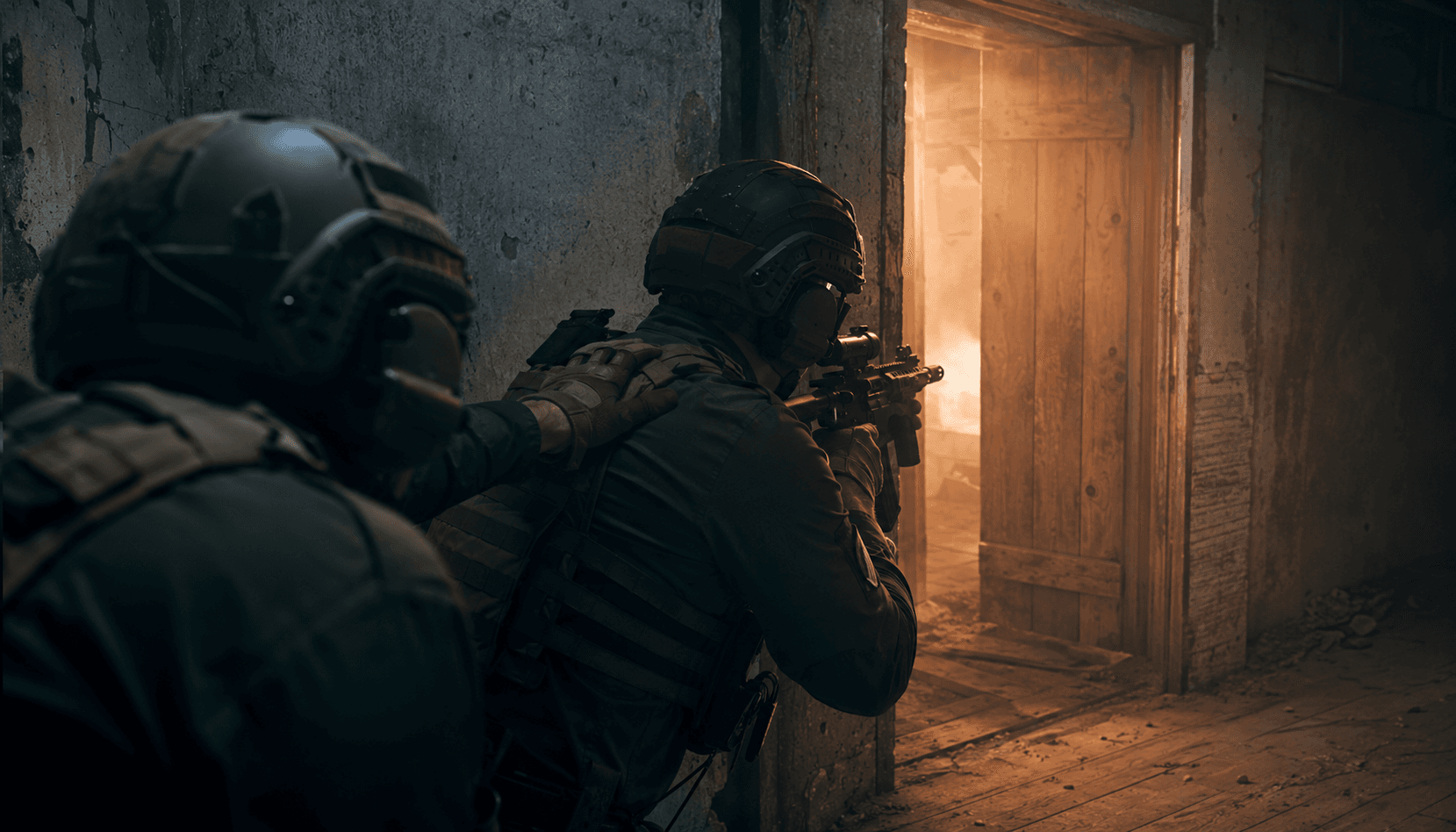
In airsoft CQB the player who hesitates at the doorway loses. The player who rushes through it without a plan loses faster. Between those two failure modes lives a small library of drills — stack, slice, hook, dominate — that turns a chaotic shoot-house into something a two-man team can actually clear.
CQB fundamentals: speed, surprise, violence of action
The doctrinal triad — speed, surprise, violence of action— comes from military room-clearing manuals and survives intact in airsoft, with one important translation. “Violence of action” in real CQB is shouts, flashbangs, breaching charges and overwhelming firepower. In airsoft it becomes decisiveness: once the stack moves, it does not stop, does not flinch, does not negotiate with the threshold.
Speed isn’t sprinting; it’s the elimination of dead time. Every pause where nobody is shooting, slicing, or moving is a gift to the defender. Surprise is timing — you choose when the door opens. The defender chooses nothing.
Airsoft adds a fourth pillar most schools don’t teach: discipline of fire. With no suppression possible, every BB needs a target. Walking through a doorway hose-spraying full-auto looks tactical and is exactly how teams kill each other with friendly fire.
The stack: 2-man and 4-man formations
A stack is the line of operators waiting outside a threshold, in physical contact, ready to flow through on a signal. It exists for one reason: turning a sequential action (entering a door) into a parallel one (multiple sectors covered the instant the team is inside).
The 2-man stack
Most realistic for airsoft. Point man stands against the wall on the hinge side or the knob side, weapon up, covering whatever angle the door already gives. Two stands directly behind him, support hand placed firmly on point’s shoulder or upper back. That hand is the radio: a single firm squeeze means I’m ready, go on your timing. Verbal cues are louder, and louder loses in CQB.
The point man never turns around to check on two. If two isn’t pressed against him, he assumes two isn’t there. Move when you feel the hand, not when you hear words.
The 4-man stack
Standard in military and law-enforcement training, harder to use cleanly in airsoft. Positions:
- #1 (point): primary entry, takes the closest hard corner.
- #2: crosses into the opposite hard corner (criss-cross) or hooks to point’s side.
- #3: enters straight, fills center-room as a floater, covers depth.
- #4 (rear security): stays at the door, holds the hallway you came from.
The error every new airsoft team makes is sending all four inside. Without #4 holding the hallway you came from, the team that just cleared the room gets shot in the back by the squad following you up the corridor.
Slicing the pie: cutting corners before entry
Slicing the pie — also called pieing the corner— is the art of clearing as much of a room as possible without ever entering it. You move in an arc around the doorframe’s outer edge, treating it as the apex of a wedge. Every step exposes a new slice of the interior while the rest of the room remains hidden behind the wall.
The geometry that matters: the further you stand from the threshold, the wider the slice each step buys you, but the longer you’re visible to anything already on your line. Stay about one meter back from the frameat 0.5–1 J energies — close enough to see, far enough that BB ricochet off the wall isn’t hitting your face.
Slicing order on a standard door:
- Easy corners first (45° and 135°). The diagonals nearest you and opposite — both partially visible from outside. Clear them while you still have wall behind you.
- Narrow cuts (90° and 150°). The slivers where a defender might be standing against the side walls.
- Hard corners (180°) last. The two corners flanking the door on your side of the room — these you cannot see until you cross the threshold.
Entry techniques: hook, button-hook, criss-cross
Once slicing has bought all the information it can, you cross the threshold. The shape of that crossing determines who lives.
Hook (sweep your side)
The point man enters and immediately sweeps along the wall on his own side, clearing the hard corner closest to where he was stacked. Simple, fast, low coordination cost. Default choice for a tired team or a small room. Weakness: both operators end up on the same side if #2 also hooks, leaving the opposite half thinly covered.
Button-hook (sweep opposite side)
Point enters and curls back along the wall opposite his stack position, effectively performing a final slice from the inside. Excellent visibility into the hard corner that was invisible during external slicing. Costs a beat of speed but gives the point man a wall at his back almost immediately. Strong choice for deliberate entries where you suspect a hard corner is occupied.
Criss-cross (split entry)
Point hooks one direction, #2 crosses behind him to the opposite hard corner. The two operators’ lanes intersect at the threshold for a fraction of a second, then diverge. Fastest way to cover both hard corners simultaneously, and the technique most favored by special-operations units for that reason. In airsoft the cost is coordination: if #2 crosses too early, point shoots through him; too late and the second hard corner is unguarded for a beat.
Points of domination: where you stop
Every operator entering a room has a pre-assigned point of domination— the corner or wall position they own once they’re inside. They get there fast and plant. They don’t wander to the middle of the room.
For a 2-man entry into a standard square room with a single door on one wall:
- #1’s point of domination: the hard corner on his side, back to the wall he entered along.
- #2’s point of domination: the opposite hard corner, back to the opposite wall.
- Sectors of fire:#1 covers from his far wall sweeping toward the opposite corner; #2 covers the mirror image. The lanes meet in the dead center, with maybe 15° of overlap — that’s the disciplined hand-off zone, not a free-fire area.
The classic mistake: the point man enters and stops atthe doorway because he’s already seen a target. He’s now blocking #2, silhouetted against the hallway, and out of position to cover his actual sector. The rule is brutal: get off the X. Push to the wall, then engage.
Threshold management: the most dangerous step
The doorframe itself — the literal line between hallway and room — is statistically the most dangerous square meter in any CQB scenario. Three rules to survive it:
- Don’t stop on it.Either you’re slicing from outside or you’re past it and at your point of domination. There is no “hovering in the doorway” tactic.
- Cross at full slicing depth.If you’ve sliced everything you can from one side, switch sides and slice from the other before committing — known as a double-slice or pieing both quadrants.
- Mind the fatal funnel. The cone of fire from inside the room widens as you approach the door. Every step closer is exponentially more visible. Slice from depth.
Airsoft realities: BB ricochet, no suppression, short ranges
Three things make airsoft CQB different from anything you’ll see in a real room-clearing manual.
BB ricochet is real. A 0.20g BB at 1 J hitting concrete or hard wood bounces with enough energy to register a hit at the wrong moment, and enough velocity to flinch you off your sight picture. Hard corners are exactly the geometry that produces rebounds. Never stack a hand or face against an exterior wall directly inside an open doorway — ricochets travel along walls.
There is no suppression.In real CQB, a defender behind cover keeps their head down because being hit means dying. In airsoft they take the BB on the cover and keep aiming. You cannot “suppress” a hardpoint by spraying it. The only currency is line of sight: deny it or take it.
Engagement distances collapse.Typical airsoft CQB room is 4 to 6 meters across. Hop-up over-tuning that’s harmless at 25 m sends BBs upward at 5 m, clearing right over a kneeling defender’s head. Set hop for the room you’re about to enter.
Gear notes for CQB
- Eyepro that won’t fog. A full-seal mask is mandatory at most Italian indoor fields; thermal lenses or active fans are not optional in the summer.
- Short replica. CQBR / SBR-length AEGs or MP-series SMGs. A full-length rifle catches the doorframe and gives away your stack.
- Single-point or convertible sling. You will transition to your secondary at least once per night, especially around stairs.
- Tracer / low FPS spring on indoor caps (often 1.0 J, sometimes 0.9 J). Check the field rules before you walk in with an outdoor build.
Calling rooms and command structure
Once a room is cleared, somebody calls it. Standard brevity used on most Italian and EU airsoft fields:
- “CLEAR” — the room is dead, no threats, ready for the next stack to flow through.
- “CONTACT [direction]” — live threat, engaging now.
- “MOVING” / “SET”— bounding overwatch handshake: I’m moving, then I’m in position.
- “LAST MAN” — the rear of the stack has crossed the threshold, the hallway is now open.
These work in person at three meters. They do not work across a 30-room shoot-house when half the squad is on a different floor. That’s where coordination breaks — and where a shared tactical layer changes the math.
Tattica Sixcloses that gap. When a stack reports a room as cleared, the squad leader drops a marker on the live map at the operator’s GPS position (“room cleared at X coordinates”), and every teammate sees it instantly on their own device. Each room’s status — cleared, contact, holding — propagates to the whole squad without anyone needing to repeat it over voice. The briefing module also lets you pre-define the stack order and the entry technique for each room in the objective: #1 hooks left, #2 button-hooks right, fallback rally point on the corridor intersection. The plan is on every screen before boots cross the threshold.
FAQ
What’s the difference between dynamic and deliberate entry?
Dynamic entry is fast, loud and high-risk: the team flows through the threshold as one and dominates the room on speed and surprise. Deliberate entry is slow and methodical: maximum slicing from outside, minimal exposure, used when you suspect a prepared defender. In airsoft you’ll lean deliberate 80% of the time — there is no flashbang to buy you the second of confusion that dynamic entry depends on.
How many operators do you need to clear a room?
Two is the realistic minimum and the sweet spot for most airsoft CQB rooms (3 to 5 meters wide). The first man takes the hard corner, the second takes the opposite one. Four-man stacks make sense in large halls or multi-door rooms, but in tight airsoft buildings they create traffic jams at the threshold.
How do you avoid friendly fire when clearing rooms?
Stay in your lane — your sector of fire ends where your teammate’s begins, do not sweep past it. Muzzle discipline at the stack, weapon pointed at the doorway, never at the man in front of you. Call the room (CLEAR, CONTACT LEFT, MOVING) so nobody behind you fires through a teammate’s silhouette.
Coordinate your next game with Tattica Six
Live GPS map, push-to-talk and shared briefing — for the squad that takes airsoft seriously.
Explore Tattica Six