
Airsoft radio brevity codes and callsigns: how to actually talk on the field
The NATO phonetic alphabet, the brevity codes you actually need, proper call structure and callsign rules — everything you need to stop clogging the net and start moving like a squad.
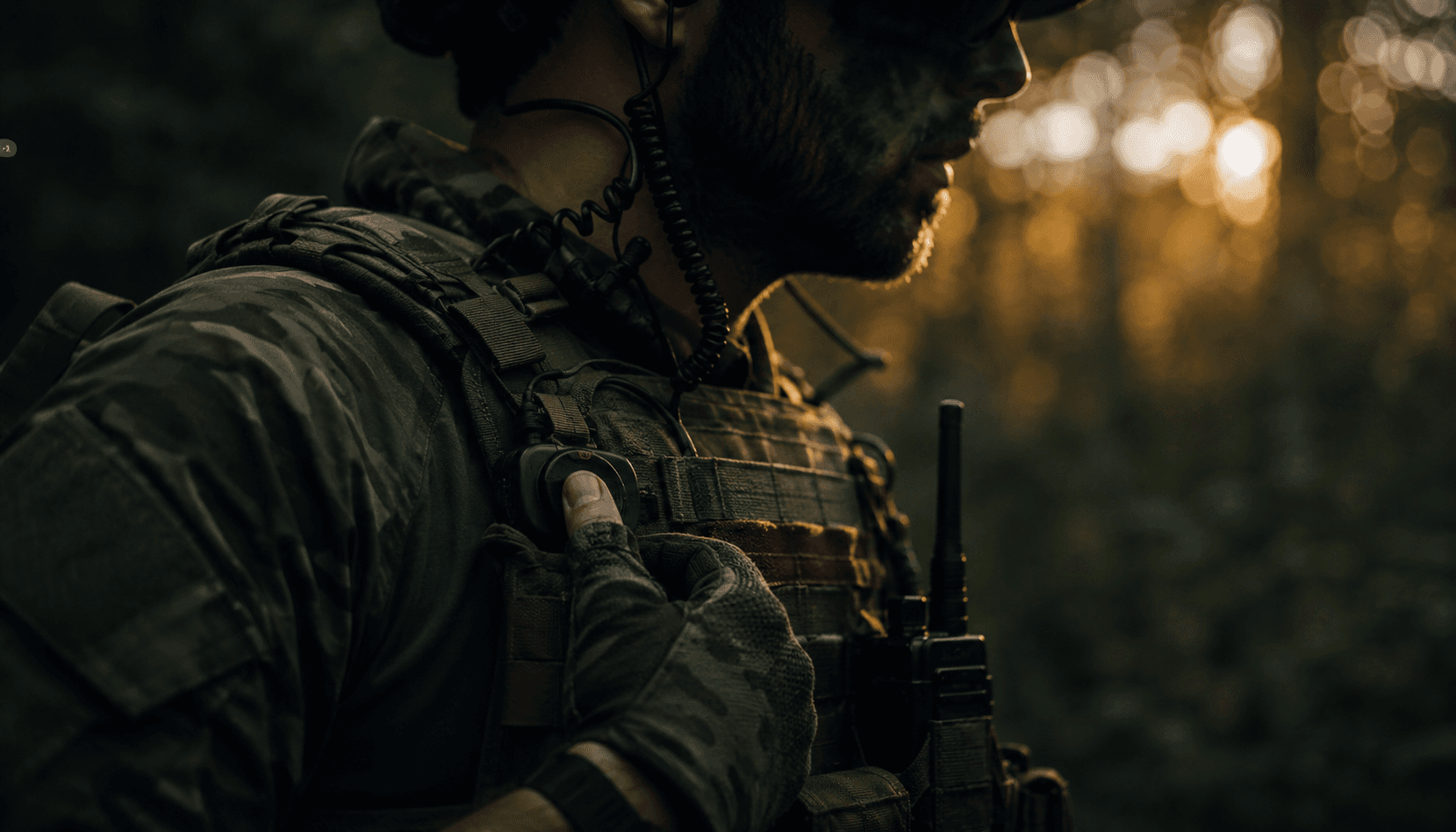
Your radio is a shared resource and every second of dead air is a second your team can’t use to call a flank or warn about a flanker. Brevity codes, the NATO phonetic alphabet and a strict call structure exist for exactly one reason: keep the channel clean so the message gets through the first time.
Why brevity matters: channel time is a zero-sum game
On a milsim radio net, only one person can talk at a time. If your squad has 6 operators and your platoon has 4 squads, that’s 24 voices competing for one frequency. The math is brutal: at 5 seconds per transmission, the channel can carry 12 messages per minute. Any operator who runs long, stutters, or doubles back to add “oh and another thing” is stealing time from someone whose contact call is actually time-critical.
Real-world military doctrine condenses this into three words — Accuracy, Brevity, Clarity— and a hard 30-second ceiling per transmission. In airsoft we don’t have artillery on the other end, but we do have ambushes, flanks and breach calls that lose all value 8 seconds late. Treat the radio like a stopwatch is running, because it is.
NATO phonetic alphabet: the whole table, plus the rules
The International Radiotelephony Spelling Alphabet, commonly called NATO phonetic, exists because under stress and over a compressed VHF channel, “B”, “D”, “P”, “T”, “V” and “Z” all sound the same. Memorize it cold. You will use it for callsigns, grid letters, vehicle plates and any time you spell.
| Letter | Code | Letter | Code | Letter | Code |
|---|---|---|---|---|---|
| A | Alpha | J | Juliett | S | Sierra |
| B | Bravo | K | Kilo | T | Tango |
| C | Charlie | L | Lima | U | Uniform |
| D | Delta | M | Mike | V | Victor |
| E | Echo | N | November | W | Whiskey |
| F | Foxtrot | O | Oscar | X | X-ray |
| G | Golf | P | Papa | Y | Yankee |
| H | Hotel | Q | Quebec | Z | Zulu |
| I | India | R | Romeo |
Three quirks worth knowing. Alfais the official ICAO/NATO spelling (because some non-English speakers see “Alpha” and say “Alf-a”), but almost everyone writes Alpha. Juliett has a double-T for the same reason: French speakers would otherwise drop the final T. Numbers have their own pronunciation set — tree for 3, fife for 5, ninerfor 9 — to distinguish them from German “nein” and similar collisions.
The 25 brevity codes you actually need
Resist the temptation to learn the entire ALSSA brevity dictionary. Most of it is for rotary-wing CAS and air-to-air, useless on a Saturday in the woods. Drill these instead.
Confirmation and acknowledgement
| Code | Meaning | When to use |
|---|---|---|
| Copy | I heard your transmission | Pure acknowledgement, no commitment |
| Roger | I received and understood | Slightly stronger than Copy |
| Wilco | Will Comply — I’ll do it | After an order you intend to execute |
| Affirmative / Negative | Yes / No | Never say “yeah” or “nope” |
| Say again | Repeat your last | Never say “repeat” — that means “fire again” |
| Stand by | Wait, I’m busy | Buy yourself 10 seconds, then come back |
| Over | I’m done, your turn | End of every transmission expecting a reply |
| Out | I’m done, conversation closed | End of exchange, no reply needed |
Contact, status and threat
| Code | Meaning | Example |
|---|---|---|
| Contact | Engaged with enemy | “Contact front, two pax” |
| Eyes on | Visual on target/objective | “Eyes on objective Bravo” |
| Friendly | That’s a teammate | Before squeezing the trigger |
| Hostile / Tango | Confirmed enemy | “Three tangos, treeline, 50m” |
| Bingo | Out of (ammo / battery / time) | “Bingo BBs, falling back” |
| Lima Charlie | Loud and Clear | Radio check response |
Movement and tempo
| Code | Meaning | Example |
|---|---|---|
| Oscar Mike | On the Move | “Bravo is Oscar Mike to RP1” |
| Charlie Mike | Continue Mission | After a pause: “Charlie Mike” |
| Hold | Stop where you are | Halt forward motion immediately |
| Push | Advance | “Push to phase line green” |
| Posh | Withdraw / pull back | Less common but useful as anti-Push |
| Frag out | Throwing a grenade | Warn friendlies before it lands |
| Drop / Down | Hit, simulated casualty | “Bravo 2 is drop, need medic” |
| Bravo Zulu | Good job | Use sparingly, at end of action |
Call structure: listener, caller, message, over
Every initial call follows the same pattern. It feels formal the first time, then it becomes muscle memory:
[callsign of listener], this is [callsign of caller], [message], over.
Listener first, because the human brain hears its own name and pays attention to whatever follows. If you start with your own callsign, half the net tunes you out before you say who you’re calling.
Example contact call, in roughly 6 seconds:
“Bravo Six, this is Bravo Two, contact front, three tangos, fifty meters, engaging, over.”
Bravo Six replies, dropping the “this is” once contact is established because the back-and-forth is now obvious:
“Bravo Two, Bravo Six, copy three tangos front. Pin them, Bravo One flanking left, out.”
Notice the asymmetry. Bravo Two ends with over because he expects a reply. Bravo Six ends with out because the order has been given — no confirmation needed, just execute.
Picking callsigns that work under fire
Good callsigns share four properties: short (one or two syllables), distinct in NATO phonetic, memorable under stress, and scalable through a fireteam, squad and platoon.
The classic structure is name + role + number: a unit is called e.g. “Bravo”, the squad leader is “Bravo Actual” (the suffix Actualindicates the named commander rather than a radio operator speaking for him), and the riflemen are “Bravo One”, “Bravo Two”, “Bravo Three”. Specialists get role names: “Bravo Doc” for the medic, “Bravo Six” for the support gunner in some SOPs.
What to avoid:
- Numbers that rhyme.“Five” and “Nine” collide. Use the airfield convention “fife” and “niner” to space them out.
- First names.“Marco, where are you?” is fine in a parking lot, useless on a 4-squad net where three teams have a Marco.
- Long or punny callsigns.“Pizza Slayer Six Actual” eats channel time every single time you transmit. Two syllables max.
- Phonetically close pairs.“Mike” and “Niner” are fine. “Mike” and “Bravo Mike” on the same net? You’ll get a misdirected call inside the first hour.
Common comms mistakes (and the fix)
Seven habits that mark you out as new on the net:
- Talking over. Two operators key up at once and neither transmission lands cleanly. If you hear someone else, release your PTT and wait three seconds.
- No callsign.“Hey, contact left!” tells nobody who is calling or who is supposed to react. Always lead with listener + caller.
- Double-pumping the PTT. Pressing, half-speaking, releasing, pressing again cuts the start of your sentence. Press, count one mississippi, then speak.
- Whispering.Either you’re close enough to whisper, in which case use hand signals, or you’re on radio — in which case speak at a normal volume into the mic.
- Running long.If you’re past 15 seconds, break the message in two: “... break, break, ...” lets someone else cut in with an emergency.
- Editorial commentary.“Uh, so I think maybe there’s like two guys, kind of?” is not a contact report. Say what you see, not what you feel.
- Reading instead of reporting. Never read coordinates off a phone without orienting them first. A wrong grid is worse than no grid.
PTT discipline and how Tattica Six fits
Every code, structure and callsign convention assumes one thing: the radio works. The PTT latency budget on a tactical net should be under 200 ms. Anything more and operators start clipping their own first word, because they can’t tell whether the channel actually opened.
Tattica Six’s voice push-to-talk is built around this constraint. There are no channels to coordinate, no pairing to forget, no PTT chord to memorize. You hold the button on screen — or the physical PTT button if you wired one — and the squad hears you. No roaming penalty across cell-LTE, no hub server to crash mid-game. Hold to talk, release to listen.
Pair the app with the discipline above and you get the rare combination that wins milsim rounds: fast radios + slow operators. Slow not in tempo, but in the deliberate, structured cadence that lets a six-person squad behave like a twelve-person platoon.
FAQ
Do I really need to use NATO phonetic alphabet in airsoft?
For single letters or callsigns, yes. Under stress, with engine noise and BBs cracking, “B” and “D” or “M” and “N” are indistinguishable. “Bravo” and “Delta” are not. It costs you half a second and saves entire misreads.
What’s the difference between Roger and Wilco?
Roger means “I received your last transmission” — nothing more. Wilco means “Will Comply” — I received it AND I’m going to do it. Saying “Roger Wilco” is redundant and technically wrong, but extremely common.
Should I say “over and out”?
Never together. Over means “I’m done speaking, your turn”. Outmeans “I’m done speaking, conversation closed, no reply needed”. They are mutually exclusive — pick one. Movies got this very wrong for fifty years.
Coordinate your next game with Tattica Six
Live GPS map, push-to-talk and shared briefing — for the squad that takes airsoft seriously.
Explore Tattica Six