
Airsoft Tactical Movement: Move Unseen in the Woods
Airsoft tactical movement guide: silent footwork, the low crawl, high crawl and 3-5 second rush, going to ground quietly and picking your next cover before you move.
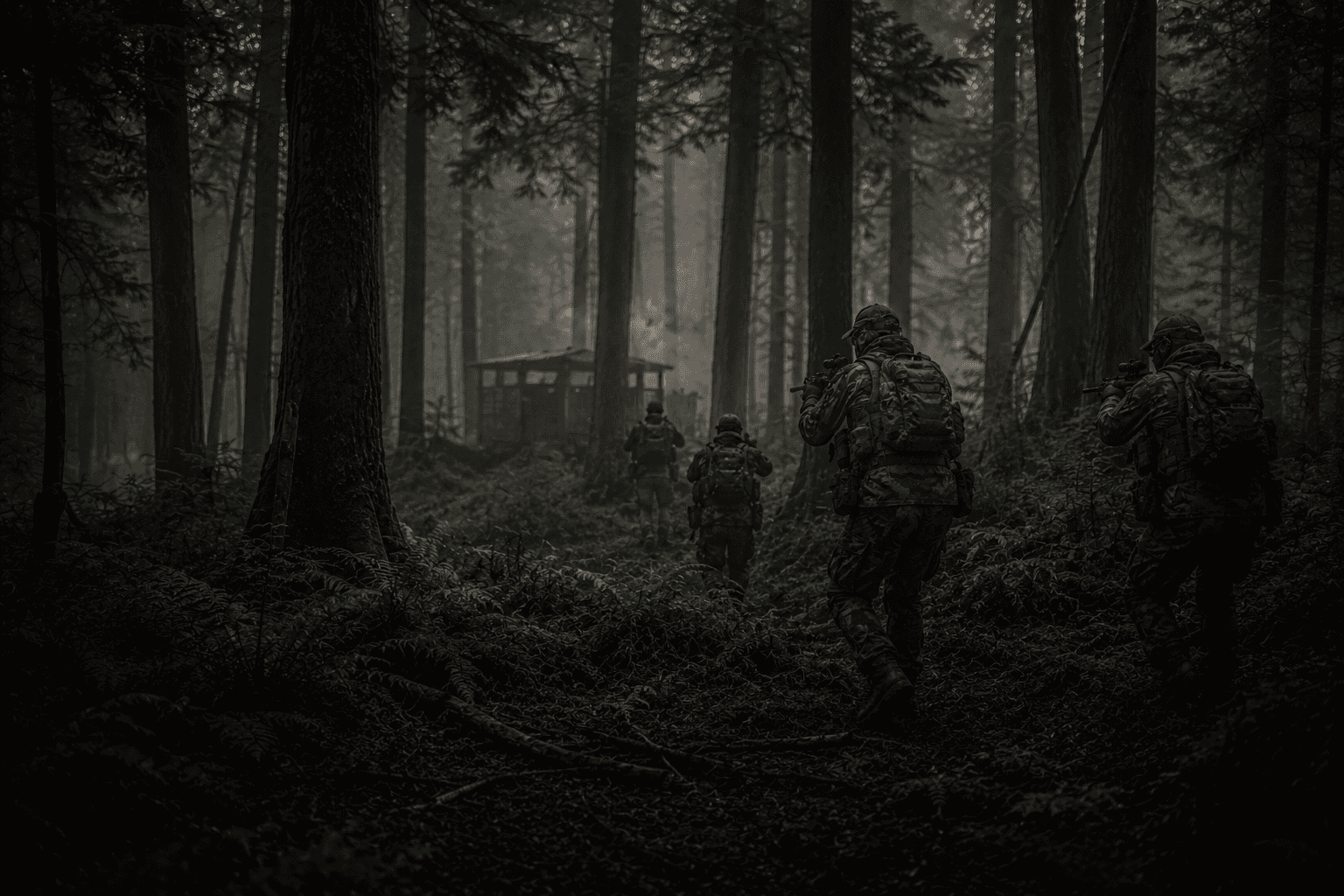
On any woodland field you will spend more time moving than shooting. The player who moves correctly arrives at the contact on his own timing, from cover, before he is seen. The player who moves like he’s late for the bus arrives loud, upright and silhouetted — and gets hit before he ever finds a target.
Why movement wins games
Military doctrine puts it bluntly: you spend more time moving than shooting. The same is true on an airsoft field. Correct individual movement is what brings you to the contact at the moment you choose, not the moment the enemy chooses. Everything that happens after the first BB flies — your angles, your cover, whether you even saw the enemy first — was decided by how you moved before it.
Movement is not a transition between the “real” parts of the game. It is the game. Treat it as a skill with its own rules, the same way you treat marksmanship, and you will win firefights you never knew were coming.
General rules of movement
These rules come straight from infantry movement doctrine and translate cleanly to woodland airsoft. None of them are optional, and none of them are difficult — they just require discipline.
- Assume the area is under observation. Always. The moment you decide “nobody can see me here” is the moment you stand up and get tagged.
- Move slowly. Count your progress in meters, not kilometers. Speed across the ground is almost never worth the noise and the silhouette it costs you.
- Don’t shake the vegetation. A swaying branch, a trembling bush or rustling tall grass betrays you long before your outline does. Move through foliage, not against it.
- Plan the route in segments. Look at the next stretch of ground before you move onto it. You advance one observed segment at a time, never blindly.
- Stop, look and listen often. A brief halt costs seconds. Walking into an ambush costs the round.
- Move during disturbances. Bursts of fire, shouting, wind — anything that distracts the enemy or masks your own noise is a window. Move in it.
- Stop and listen when birds or animals are alarmed. Wildlife reacting to something you can’t see is a warning. The something might be the enemy.
- Don’t move straight forward out of a firing position. If you fired from a spot, the enemy knows the spot. Change direction slightly so you don’t reveal a predictable pattern.
- Avoid open areas, hilltops and ridgelines. Cross roads and trails at the points with the most cover — bends, narrow stretches, low ground.
Foot placement by terrain
Most of the noise a moving player makes comes from their feet. The fix is not “walk quietly” — it is placing the foot differently depending on what you’re walking on. The master rule sits above all of it: before you commit any part of your body to a piece of ground — foot, knee or torso — make sure it is clear of obstacles that snap, crack or roll.
| Terrain | How to place the foot | Pace |
|---|---|---|
| Soft ground (loose earth, leaves) | Heel down first, then roll the rest of the foot forward, checking your balance. | Slow |
| Hard ground (packed earth, stone) | Toe down first; the contact is secure, so the footing is reliable. | Slightly faster |
| Grass / vegetation | Lift the foot in one motion over the vegetation, then set it down flat, sole parallel to the ground, avoiding twigs. | Slow and deliberate |
The stealth walk
When you genuinely need to move silently, the whole body changes. Keep your replica at the ready. Take short steps. Keep your weight on the rear foot while the front foot tests the ground, and let the front foot touch down toe-first. In dense vegetation, carry the replica in one hand and use the other out in front of you, feeling and parting the foliage so it doesn’t whip or snap.
Moving under threat: crawl and rush
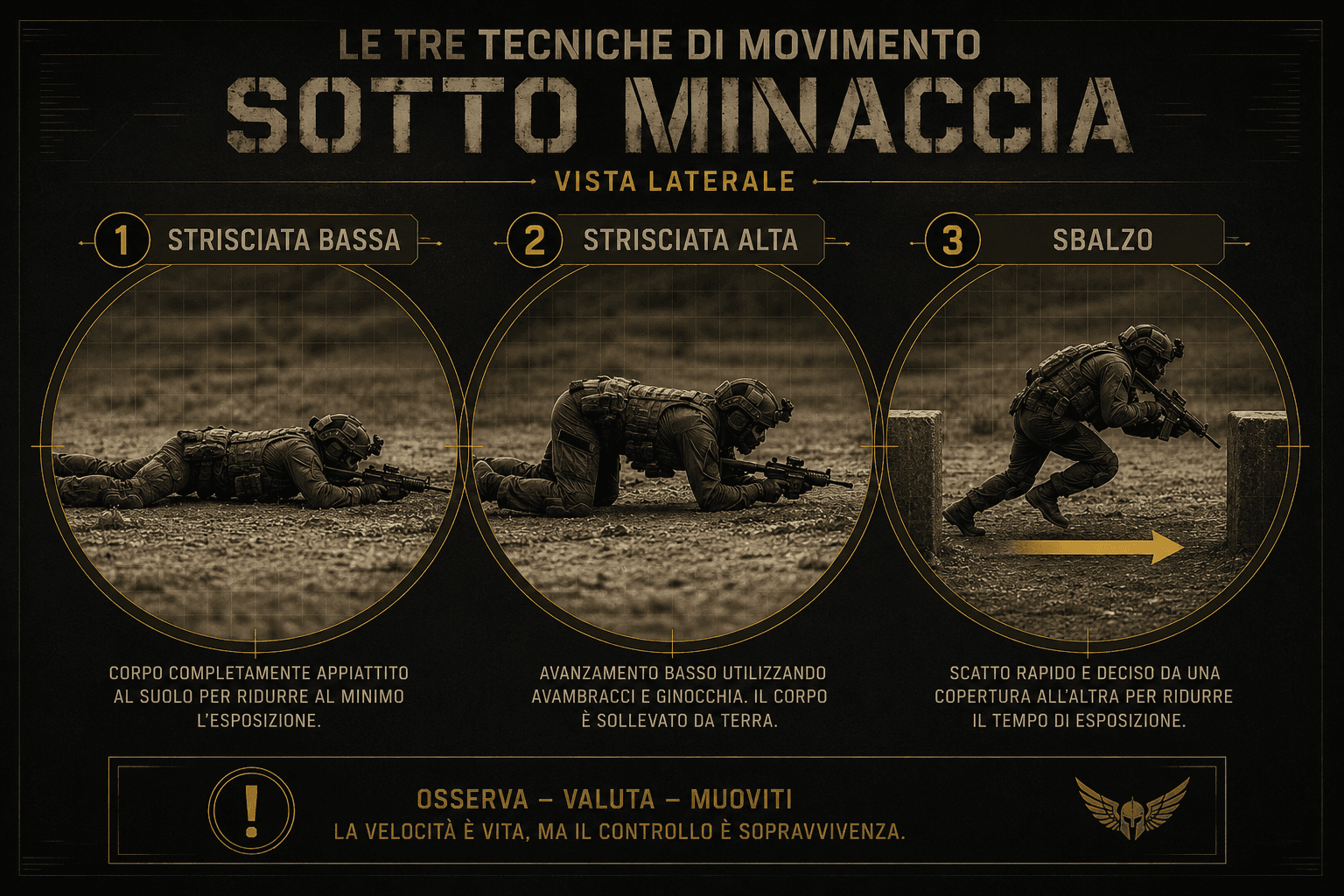
Walking — even a careful stealth walk — is for when you are not yet under an enemy’s direct line of sight. Once you are, doctrine gives you three movement methods. Two are crawls; the third is the rush. You choose between them based on how much concealment you have and how close and alert the enemy is. The same logic underpins good camouflage— movement is one of the classic seven S of staying invisible.
The low crawl
The lowest possible silhouette. Use the low crawl when concealment is very low and the enemy is close or has a clear view of your position — or when you are occupying a firing position. Your body is flattened against the ground. Hold the replica by its sling, alongside your body, with the muzzle kept clear of the dirt. You push forward with your arms and one leg, advancing a few centimeters at a time. It is slow, it is uncomfortable, and on an open lane under observation it is the only thing that keeps you in the round.
The high crawl
Faster than the low crawl, still a low silhouette. Use the high crawl when there is good concealment but enemy fire still stops you from standing up. Your body is lifted off the ground, riding on your forearms and shins. The replica is cradled between your arms with the muzzle clear of the dirt. Keep your knees well back behind your buttocks so the body stays low. You advance by moving opposite elbow and opposite knee together — a smooth, alternating crawl that eats ground far faster than the low crawl while still keeping you under most lines of fire.
The 3-5 second rush
The rush is the fastest way to get from one piece of cover to another. The single rule that governs it: every rush must last three to five seconds — short enough that an enemy shooter cannot track you and settle their sights before you disappear. The full sequence, from prone:
- From the prone position, raise your head slowly and choose your next position and the route to it.
- Lower your head slowly.
- Draw your arms in toward your body, elbows tucked in.
- Pull one leg forward.
- Raise your body by straightening your arms.
- Get up quickly.
- Run to the next position.
One detail decides whether the rush works at all. If you spent any time firing from a position, the enemy already knows where you are and is waiting for you to pop upright there. Before you rush, roll or crawl a short distance to the side and stand up from a different point — you defeat anyone aiming at the old spot. On a route that crosses an open area, run the rush in a zig-zag rather than a straight line, so a shooter can never lead you cleanly. Rushing the instant the enemy opens up is also the core of your contact battle drills: react, get down, then bound.
Going to ground silently
Sometimes you need to go from standing to prone without making a sound — to listen, to observe, to avoid being seen. Dropping flat is loud and obvious; going to ground is a controlled, six-step move:
- Hold the replica tight in one hand, alongside your body, muzzle pointed up.
- Bend your knees slowly.
- With your free hand, feel the ground — check it is clear of dry twigs, stones and noisy leaves.
- Lower one knee at a time into the area you have already checked.
- Transfer your weight onto your hand, extend your legs back — in the direction you came from, which you know is clear — and lower yourself flat.
- Roll to one side if needed and take up your firing position.
The logic of step five is worth dwelling on: you extend your legs back toward ground you have already walked over. You know it is clear because you were just standing on it. Reaching a leg out blindly into uncleared ground is exactly how a quiet approach ends with a snapped branch and a hundred heads turning.
The stop-and-listen halt
Stop, look and listen often. This matters by day and matters even more by night. During a listening halt, settle into a comfortable position, ideally with your face slightly into the wind so it carries sound and scent toward you.
Then give your senses time. It takes a few minutes for you to “acclimatize” — to learn which sounds and smells of this particular patch of woodland are natural and which are not. A player who halts for ten seconds and moves on has learned nothing. A player who halts for two full minutes has built a baseline.
Choosing your next cover
This is the rule that most separates the disciplined player from the hasty one: choose your next covered position before you move. Never run “forward and then we’ll see.” Before every rush, your eye has already identified three things: where the next cover is, which route gets you there, and what that cover actually does — the difference between cover and concealment decides whether it stops a BB or merely hides you. You move with a destination, not a hope.
Guidelines for the choice:
- The position should offer cover and concealment — preferably both. Cover stops the BB; concealment hides you. The best next position does both.
- Don’t force yourself to silhouette along the route. A position you can only reach by skylining yourself on a ridge is the wrong position.
- Avoid obvious kill zones. It is better to go around difficult ground than to fight through it at a disadvantage.
- Cross open stretches quickly and along the shortest exposed route. If you must be in the open, be in it for the minimum possible time.
There is a tension built into all of this. Good movement means moving slowly, spreading out, going to ground, and crawling — all of which cost you visual contact with your own squad. The teammate you could see a minute ago is now a low shape in the ferns forty meters away, and turning your head to find him means breaking your own movement discipline. Moving as a unit makes this worse: holding a squad formation or running bounding overwatch— one element covers while the other moves — depends on everyone knowing where everyone else is. This is exactly the gap Tattica Six closes. The live GPS map keeps every player’s position visible on your iPhone or Apple Watch, so a dispersed, slow-moving squad stays aware of each other without anyone standing up, calling out, or shaking a bush to relocate a buddy. You can bound, crawl and halt on perfect discipline and still know, at a glance, that your overwatch is set and your flank is where it should be. Push-to-talk voice and the shared briefing layer do the rest — the plan is on every wrist before the first segment of movement begins.
FAQ
How long should an airsoft rush last?
Three to five seconds, from the moment you stand up to the moment you are back on the ground behind cover. That window is short enough that an enemy who spots you cannot raise their replica, settle their sight picture and track you before you disappear. Use the mnemonic “I’m up — he sees me — I’m down”: if you finish the phrase and you are still standing in the open, your rush was too long.
Low crawl or high crawl — which one do I use?
Use the low crawl when concealment is very low and the enemy is close or has a clear view of your position — it gives the lowest possible silhouette but is slow. Use the high crawl when there is good concealment but enemy fire still stops you from standing: you ride on forearms and shins, faster than the low crawl while staying low. The rule of thumb is concealment height first, speed second.
Why shouldn’t I move straight forward out of a firing position?
If you stayed in a position long enough to fire from it, the enemy now knows roughly where you are and is watching that spot. Moving straight forward from it reveals a predictable pattern. Before you rush, roll or crawl sideways a short distance and stand up from a different point — anyone aiming at your old position is now aiming at empty ground. On open routes, rush in a zig-zag.
How do I go prone without making noise?
Hold your replica tight in one hand, muzzle up. Bend your knees slowly, and with your free hand feel the ground for dry twigs, stones and noisy leaves before you commit any weight. Lower one knee at a time into the area you already checked, shift your weight onto your hand, extend your legs back toward the direction you came from — ground you know is clear — and lower yourself flat. Roll to one side if needed and take up your firing position.
Coordinate your next game with Tattica Six
Live GPS map, push-to-talk and shared briefing — for the squad that takes airsoft seriously.
Explore Tattica Six