
Airsoft Camouflage Guide: 7 S, Face Paint & Ghillie
Airsoft camouflage guide: master the 7 S that give you away, woodland camo, face paint zones, ghillie suits and the 5 fieldcraft disciplines to stay unseen.
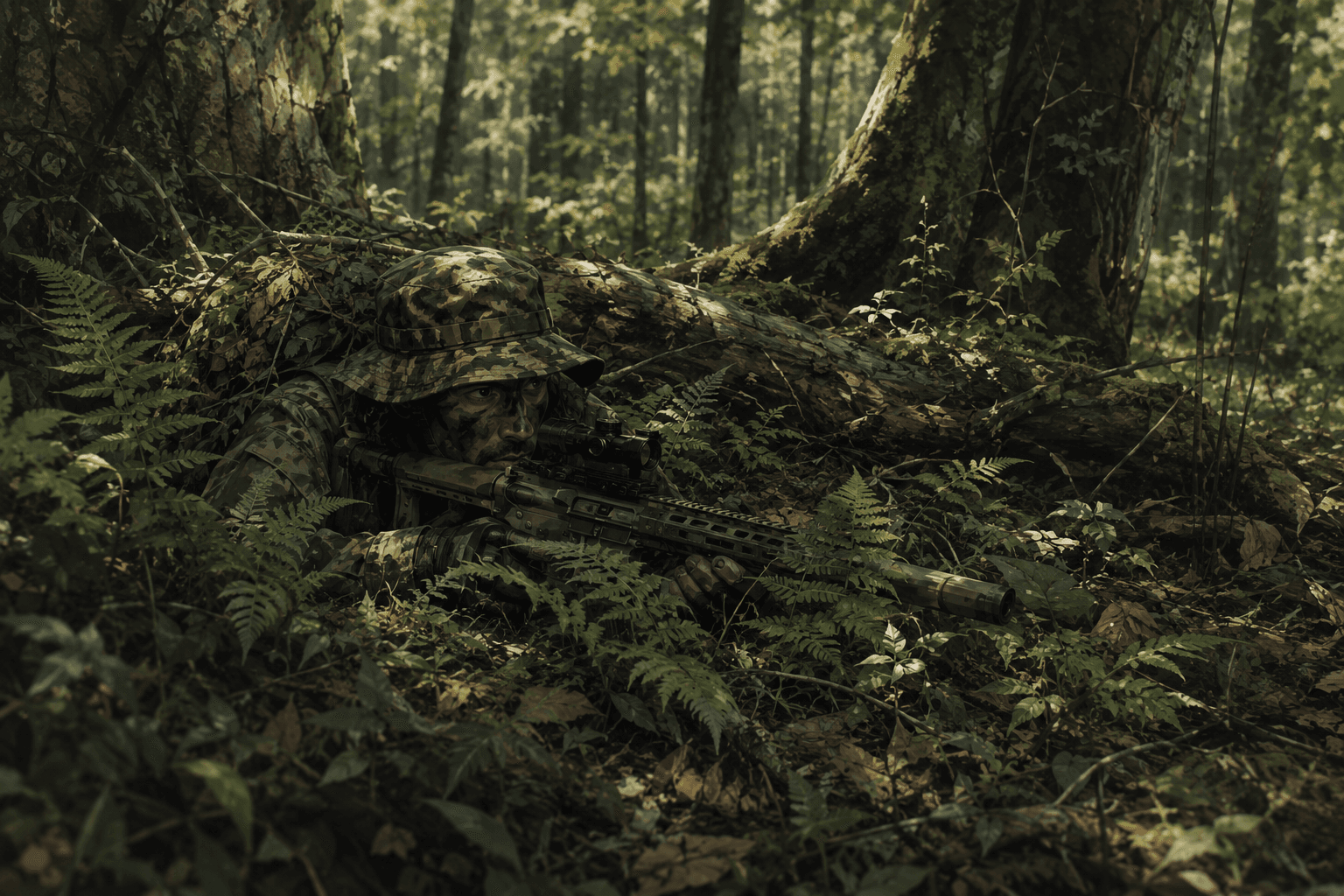
The player who wins a woodland firefight is rarely the one who shot first — it is the one the enemy never managed to find. Camouflage is the craft of making yourself, your gear and your position not look like what they are. It will not turn you invisible, but it buys you the seconds that decide the engagement.
What camouflage really does
Camouflage is everything you use so that you, your equipment and your position do not look like what they are. That is the entire definition, and it is worth holding onto, because it sets the right expectation. Camouflage does not make you invisible. It reduces the probability and the speed with which the enemy detects you.
That distinction matters on the field. A player wrapped head to toe in the perfect woodland pattern will still be found in seconds if he moves fast, lets an optic flash, or stands tall against a pale sky. Camouflage is a system, and the system only works if every part of it holds. The most useful framework for understanding what betrays you — and therefore what your camouflage has to defeat — is the 7 S.
The 7 S: what gives you away
The 7 S is the sniper’s checklist of giveaways. Each S is a signal the human eye and brain are wired to catch. Work through all seven and you have worked through camouflage.
Shape
The brain recognises the human profile — and the profile of a weapon — almost instantly. Break the outline: vegetation fixed to the body and the helmet, irregular patterns, nothing that reads as a clean silhouette. An advanced trick: using different textures and tones on your torso and your legs “cuts” the human figure in half and makes it far harder to recognise as a person.
Shine
Any smooth surface reflects: lenses, buckles, the barrel, the optic. A reflection grabs attention instantly and is visible at great distance. The fix is matte: matte paint, fabric tape, lenses covered with mesh or netting so they cannot flash.
Shadow
Shadow hides — move inside it. But the shadow you cast on open ground, or a shadow that shifts while everything else is still, betrays you. Never shoot from the edge of the treeline; shoot from inside the woods, in the shadow of the canopy. Camouflage hides you, but it never stops a BB — understand the difference between cover and concealment before you trust a hide.
Silhouette
A figure outlined against a uniform background — the sky, a pale wall — is one of the most relentless signals there is. Never silhouette yourself on the horizon or a ridgeline; this is “skylining” and it kills snipers. Stay low: crouched or prone, the silhouette almost disappears.
Surface and colour
Colour and texture have to agree with the environment. Matching the colour is the number one factor: if you can match the colours, you are hidden. A green uniform contrasts against snow; a woodland pattern fails in dry, dead ground. Choose the surface for the field you are actually on, not the field on the box art.
Spacing
Objects at regular, equal distances are unnatural — nature does not space things on a grid. This applies to the whole squad: never line up in a straight, evenly spaced row. A regularly spaced cluster of figures reads as “team” to anyone scanning the treeline. Irregular, terrain-driven squad formations and spacing keep the whole team from giving itself away at once.
Movement
Movement attracts attention. The eye is drawn to it, and fast, abrupt movement is detected far quicker than slow movement. Everything you do in the woods — short of an emergency — should be done slowly: turning your head, changing posture, raising the weapon. This is why slow, deliberate tactical movement is camouflage in its own right. Sound is the twin of movement, and it gets its own treatment in the 5 disciplines below.
Hiding, blending, deceiving
Sniper doctrine defines three methods of camouflage, used alone or in combination. Knowing which one the terrain allows is half the decision.
- Hiding. Concealing the body completely from observation — behind dense vegetation, in a fold of the ground. It is the simplest and the most effective method whenever the terrain allows it.
- Blending. Adapting your personal camouflage to the environment to the point where you “dissolve” into the background. This is the work of colour, texture and local vegetation.
- Deceiving. Leading the enemy to false conclusions. In airsoft this is, for example, making noise or showing movement on one flank to pull attention there while the squad advances from another.
Natural vs artificial camo
Camouflage materials split into two families, and the best loadouts use both.
Natural camouflage is vegetation and material from the place itself — grass, leaves and branches fixed to the body and the equipment. There is one non-negotiable rule here: always add vegetation from the same field you are playing on, and change it the moment it wilts. Yellowed, withered foliage betrays you just as badly as having none — a dead branch on a green man is its own kind of signal flare.
Artificial camouflage is paint, tape, netting, ghillie material and face paint. It is the durable base layer; natural vegetation is what you build on top of it, fresh, every game.
Face paint done right
Exposed skin reflects light because of its natural oiliness — the face is one of the biggest giveaways on a player. The master rule is simple and it is the opposite of what most beginners do: the parts of the face that fall in shadow are lightened; the parts that shine are darkened. You are flattening the face, removing the three-dimensional cues the eye uses to read a human head.
| Zone | Why | Colour |
|---|---|---|
| Forehead, cheekbones, nose, chin, ears | These zones shine — they catch the light | Dark |
| Around the eyes, under the nose, under the chin | These are shadow zones | Light |
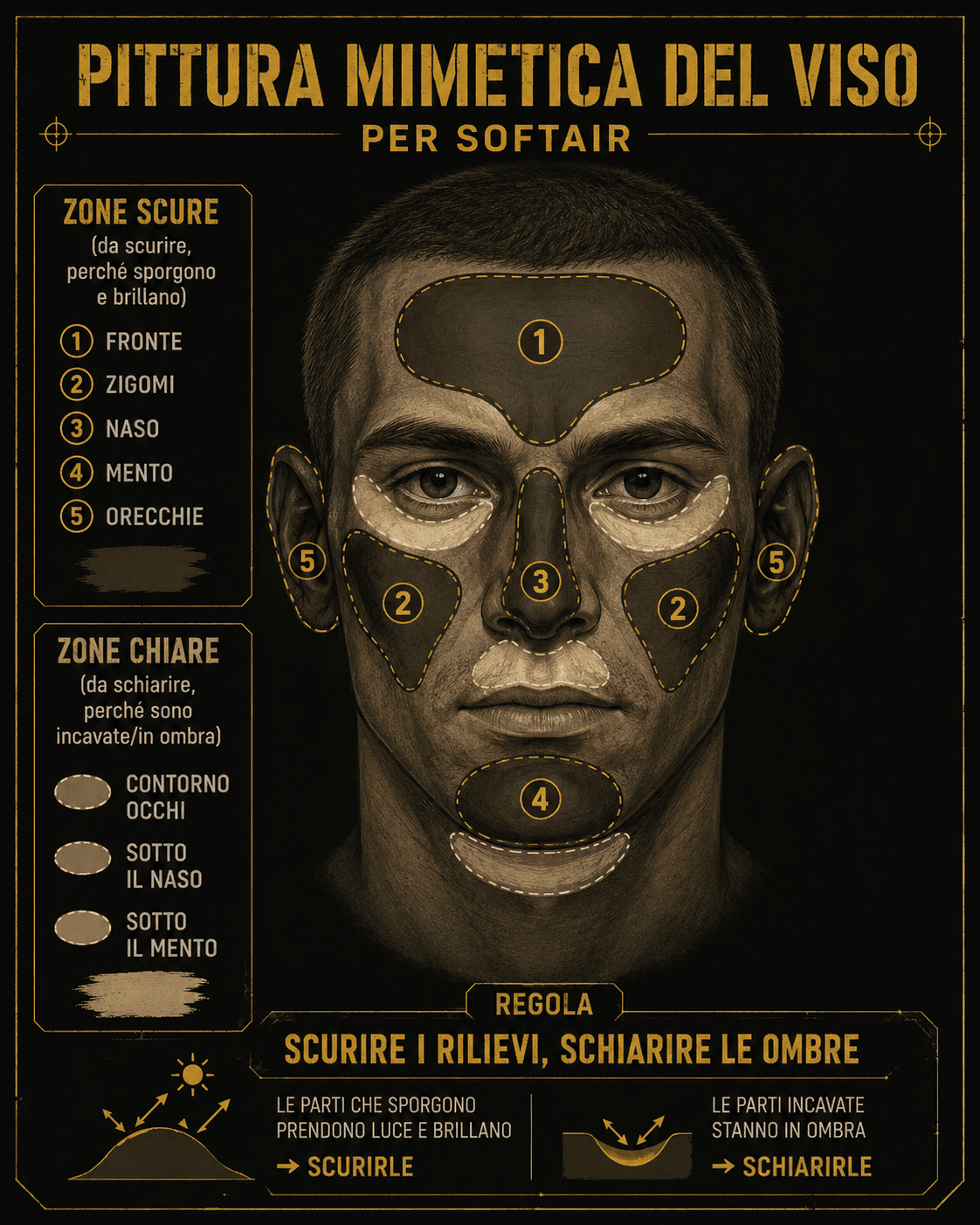
There are three patterns, chosen for the terrain:
- Striping. For woodland with thin, sparse vegetation. Diagonal stripes run across the face, overlapping two or more colours.
- Blotching. For dense, leafy woodland. Irregular patches rather than lines.
- Combination. The best general-purpose pattern, for terrain that changes as you move through it.
Equipment and replica camo
Camouflage your equipment, but without compromising how it works. That caveat is doctrine: a rifle you cannot operate because you taped it solid is worse than a shiny one.
On the replica:
- Mask the perfect circles. The muzzle and a suppressor read as unmistakable man-made shapes. Break them up.
- Break the straight lines of the barrel with tape — the long, rigid line of a rifle is a Shape giveaway.
- Stop the optic shining. Mesh or a kill-flash over the lens; an uncovered scope is a flashing beacon every time the sun catches it.
- Lose the black boots. Black footwear jumps out of a woodland scene. Cover them or choose earth-toned boots.
Ghillie suits
The ghillie suit is a garment covered in strips of jute or netting that breaks up the human shape. It is the camouflage base of the sniper role — the classic “moving bushes.” A few essentials:
- It is only a base. It does not make you invisible — always add local vegetation on top.
- The garnish — the strips — must not be so long at the front that it blocks your vision or movement.
- It has to agree with the environment. A striped ghillie in dense woods, or a leaf ghillie in a grass field, are both wrong.
In airsoft the ghillie is generally reserved for the sniper. For the average player good camouflage is simpler and just as effective: a uniform in the right colour, a broken outline, local vegetation added to body and gear, and covered skin. You do not need a ghillie to disappear — you need to defeat all 7 S.
The 5 disciplines
Camouflage is what you wear. The 5 disciplines are what you do — the behaviours that stop you betraying yourself. Every member of the squad has to master all five.
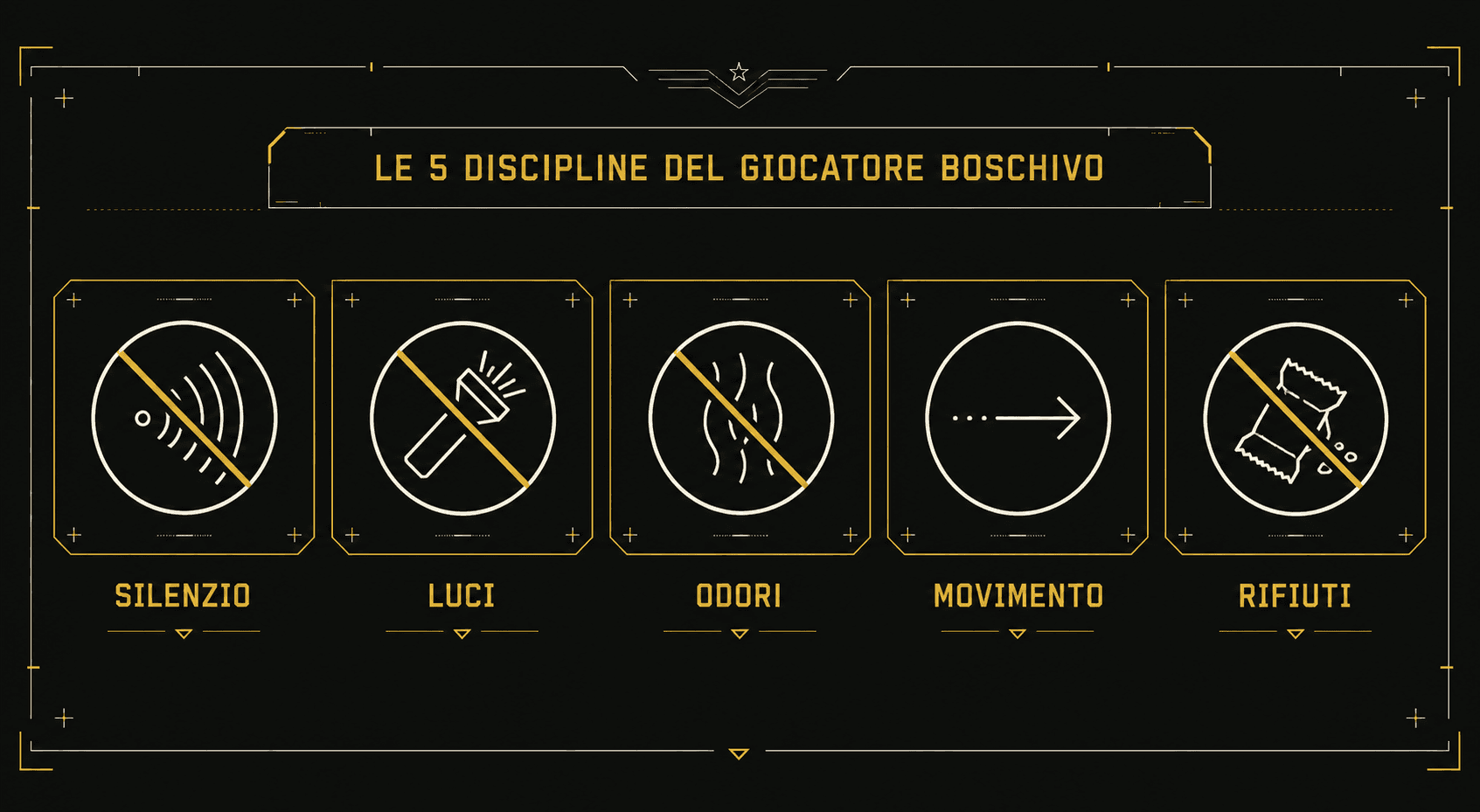
1. Noise discipline
Noise is the number one enemy. Talk as little as possible and use silent hand signalsinstead of your voice. Condition your equipment so it does not rattle — the practical rule is to put on all your gear and jump up and down: whatever makes noise, fix it with tape, foam or by repositioning it. Exploit background noise: wind in the branches can cover your steps over dry leaves.
2. Light discipline
Cover everything that reflects or emits light. Use a torch only shielded, to read a map. Cover the power LEDs on radios and optics. At night, do not smoke — the ember marks your position precisely.
3. Smell discipline
Artificial smells are sharply noticeable in the woods — food, cigarettes, soap, insect repellent, deodorant. Cut them down before the game starts.
4. Movement discipline
Always move in shadow; never silhouette yourself on the horizon or a ridgeline; always use tactical handholds — cover. Remember the hard truth: darkness protects you from sight, but not from fire.
5. Litter discipline
Leave no litter and no trace. A snack-bar wrapper on a small trail tells the enemy that someone passed through — and which way they went. Beyond the tactical cost, trashing the field is a disrespect to the terrain and to the other players.
And here is where coordination becomes the hidden cost of good camouflage. When camouflage is working, the squad goes silent — no chatter, slow movement, members dispersed and invisible to each other as much as to the enemy. That is exactly when teams lose track of one another and break formation. Tattica Six closes that gap: the live GPS map shows every hidden teammate’s position without anyone standing up or calling out, and push-to-talk voice lets the squad leader pass a brief order without breaking noise or movement discipline. The shared mission briefing fixes rally points and sectors before the game so a dispersed, well-camouflaged team can stay one unit while every individual stays invisible.
FAQ
Does camouflage make you invisible in airsoft?
No. Camouflage makes you, your gear and your position not look like what they are — it reduces the probability and the speed with which the enemy spots you, nothing more. A perfectly camouflaged player who moves fast, shines an optic or talks loudly will still be found. Camouflage is what you wear; discipline is what you do, and you need both.
What are the 7 S of camouflage?
The 7 S are the seven indicators that betray a hidden position: Shape, Shine, Shadow, Silhouette, Surface (texture and colour), Spacing and Movement. Each one is a tell the human eye and brain latch onto. Defeating all seven — breaking your outline, killing reflections, staying in shadow, never skylining, matching colour, spacing the squad irregularly and moving slowly — is the whole job of camouflage.
How do you put on airsoft face paint correctly?
Follow the master rule: darken the parts of the face that shine and lighten the parts that fall in shadow. Forehead, cheekbones, nose, chin and ears catch light, so go dark; the eye sockets, under the nose and under the chin are shadow zones, so go light. Use stripes for thin woodland, blotches for dense foliage, or a combination for mixed terrain. The number one mistake is forgetting the neck, the ears (including behind them) and the backs of the hands.
Do I need a ghillie suit to play airsoft?
No. The ghillie suit is the camouflage base of the sniper role — the classic “moving bushes” — and it is generally reserved for that role. For the average player good camouflage is simpler: a uniform in the right colour, a broken outline, local vegetation added to the body and equipment, and covered skin. A ghillie is only a base anyway: it never makes you invisible and always needs local foliage added on top.
Coordinate your next game with Tattica Six
Live GPS map, push-to-talk and shared briefing — for the squad that takes airsoft seriously.
Explore Tattica Six