
Airsoft Hand Signals: Squad Chart & Callouts
Master airsoft hand signals with a 12-signal squad chart, illustrated diagram and the full communication hierarchy — silent signals, voice callouts on contact and radio.
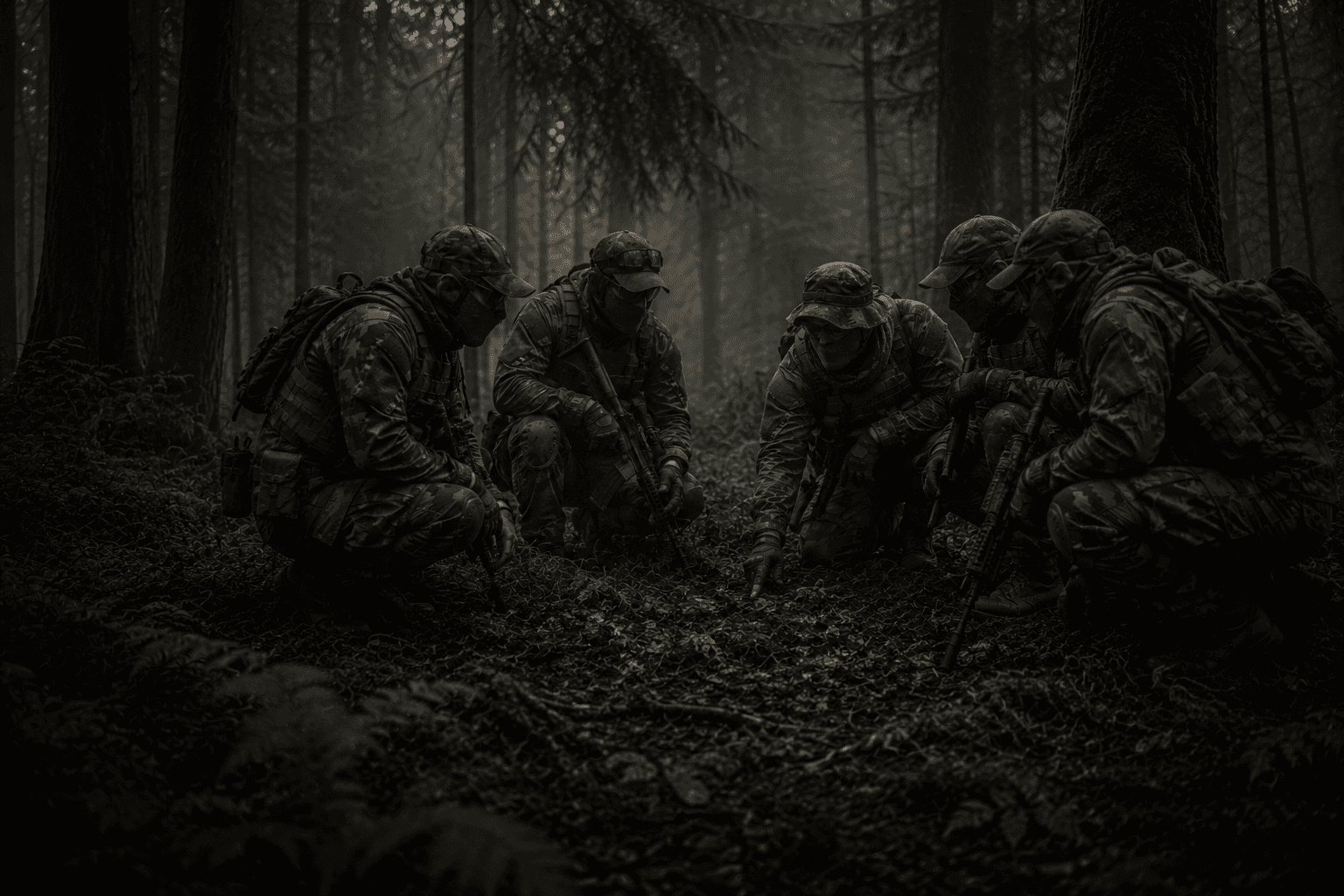
In a squad, communication is control. Take it away and eight players become eight individuals moving in the same woods by coincidence. Before a single shot is fired, that control is silent — and it lives entirely in the hands.
Why signals come first
A patrol moving through the woods before contact has one overriding priority: stay undetected. The squad that gives away its position by talking has already lost the surprise that silent movement bought it. So while the squad is still unspotted, the entire chain of command runs without a word — through hand signals.
This is not a stylistic choice. Hand signals are the primary method of control for everything that happens before the first BB flies: halts, direction changes, formation changes, listening stops, the moment someone spots the enemy. The leader gives an order, it ripples down the column, and nobody breaks the silence that keeps the squad alive.
Halts are the clearest example. When the lead element stops, the whole squad needs to stop, face outward and cover its sector — and it needs to happen without an order being shouted down the line. A raised closed fist passed from player to player does in two seconds, silently, what a verbal command could never do without betraying the patrol. Silent movement and silent control are two halves of the same discipline: our camouflage and movement guide covers the staying-unseen side that makes hand signals worth using at all.
The two unbreakable principles
Every workable airsoft hand-signal system rests on two rules. Break either one and the system stops being reliable.
One: every signal uses one hand only
The standard set is built so that every signal can be made with a single hand. The reason is simple and non-negotiable: the player’s other hand keeps the replica shouldered and ready to fire. A signal that demands two hands forces a teammate to break their firing grip every time they need to relay an order. A squad whose members are constantly un-shouldering to talk is a squad that cannot react the instant contact happens. Control should never cost you readiness.
Two: every signal must be rehearsed
A signal is only information if the receiver decodes it correctly. A closed fist means halt only because the whole squad has agreed it means halt and has practised reading it. An unrehearsed signal is just a gesture — and a gesture that half the squad guesses at is worse than no signal, because it produces confident, wrong action.
That makes rehearsal a mandatory part of the briefing, not an optional extra. Run the full signal set before every game, and run it twice with new players or a pick-up team. The goal is recognition with zero thinking: the hand goes up, the body responds, no interpretation in between.
The essential airsoft hand signals chart
This is the base set every airsoft squad should agree on and rehearse. It is small on purpose: a dozen signals that cover the situations that actually arise, all readable with one hand. Adapt it to your team, but agree on it before you walk on the field.
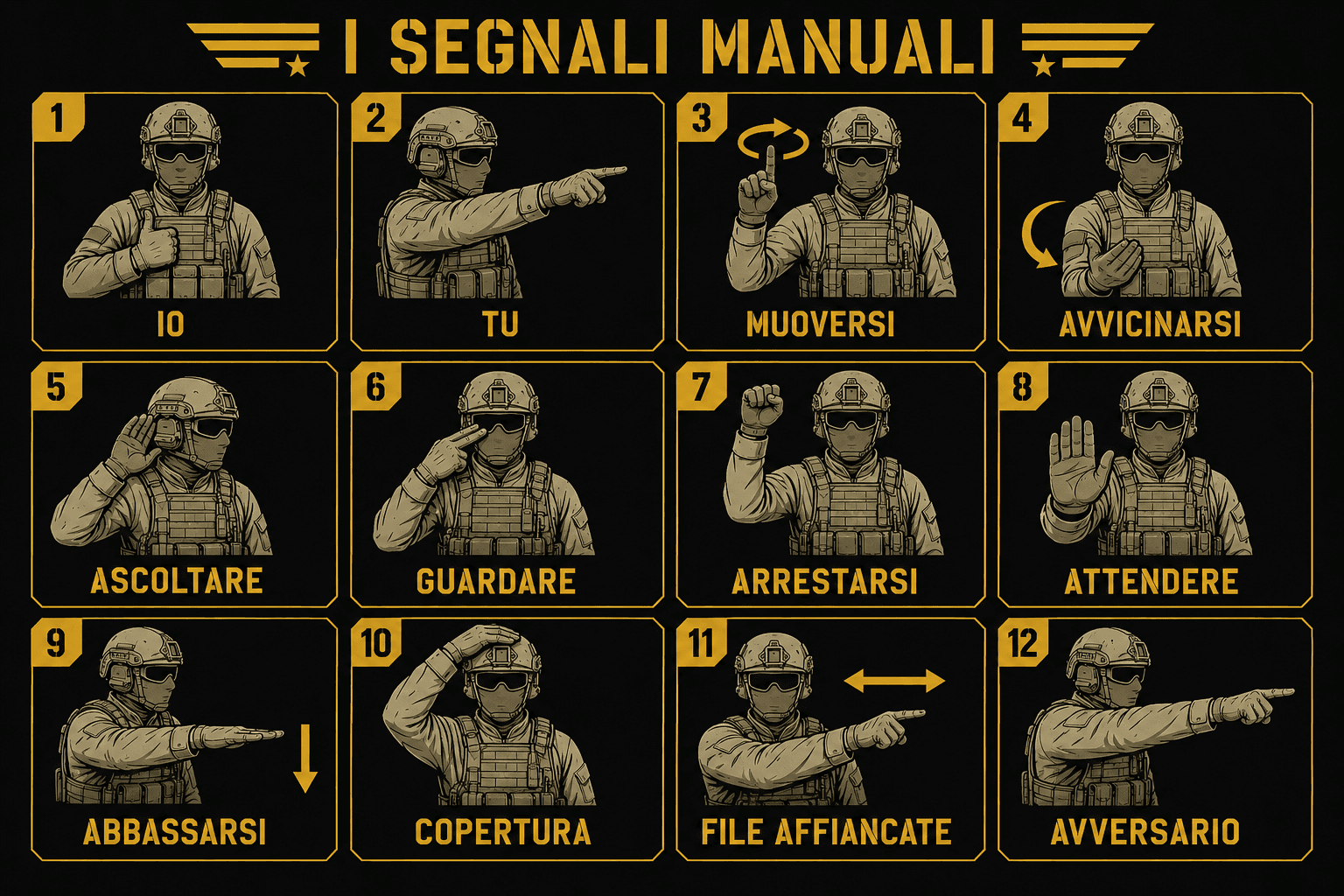
| Signal | Meaning |
|---|---|
| Raised closed fist | Halt / stop |
| Open hand, palm down, lowering | Get down / move low |
| Arm sweeping overhead toward a direction | Advance / move in that direction |
| Hand cupped to the ear | Listen / “I’m listening” |
| Finger to the lips | Silence |
| Hand circling overhead | Rally / regroup on me |
| Pointing (to the eyes, then to a spot) | Check that spot |
| Thumbs up | Affirmative / acknowledged |
| Hand drawn across the throat | Order not understood / cease |
| Fist pumping forward and back | Out of ammo |
| “Enemy” signal + fingers held up | Contact — and how many |
| Arms shaping a formation | Order the matching formation (line, column, wedge) |
Two signals on that chart deserve a closer look. The throat cut — a flat hand drawn across the throat — does not mean “kill” in this system; it means I did not understand or cease that action. If a teammate answers your signal with a throat cut, repeat it more clearly. The out-of-ammo signal — a fist pumped forward and back — tells the player’s partner to cover the gap in fire while the reload happens, which is exactly the kind of order that cannot wait for line-of-sight clarity.
Signalling formations
Formation changes are given with the arms, big enough to be read from several metres back in poor light. Each of the standard squad formations has its own arm shape:
- Line — both arms held out horizontally, the body itself drawn as a line.
- Column — one arm raised straight up, marking the single-file stack.
- Wedge — both arms angled down and back from the shoulders, tracing the V of the wedge.
Because these are full-arm signals they are the one place you may briefly break the one-hand rule — but only briefly, and never in a position where contact is likely. The leader signals the new formation, waits for thumbs up to ripple back, and only then starts moving the squad into it.
The communication hierarchy
Hand signals are the first channel, not the only one. A squad uses three channels, and the skill is knowing which one the current situation demands. Run from the most silent to the least:
- Silent — hand signals. While the squad is undetected. Primary control for all pre-contact movement.
- Contact started — voice callouts. Once shooting begins, silence is already broken; speed beats stealth. Standardized callouts take over.
- Distant sub-teams — radio. When elements are too far apart to see or hear each other, radio carries control across the gap.
And the one thing that never works, at any range: shouting long, improvised instructions in the middle of a firefight. By the time a sentence like “hey, the guy who was behind the second tree is now moving toward the left flank, can someone go cover that?” finishes, the situation has already changed. The hierarchy exists precisely so that nobody has to.
Callouts: voice on contact
The instant contact starts, silence has done its job and lost its value. Now the squad needs information moving fast, and that means the voice — but a disciplined voice. A callout must be short, clear and precise, and it follows one consecrated format:
The order is deliberate. What tells the squad there is a threat at all. Distance tells them how urgent it is. Direction tells them where to orient their weapons and their attention. Three words, one breath, zero ambiguity — and because the structure never changes, every teammate parses it identically.
Beyond the contact callout, a squad should standardize a handful more so they too become reflexive:
- “Reloading!” — tells your partner to sustain fire while you swap.
- “Ready!” — you are back up and able to fire.
- “Moving!” — you are about to displace; cover expected.
- “Covering!” — you have eyes and fire on the threat; partner can move.
- “Grenade!” — a thrown device is incoming or out.
- “Falling back to [point]!” — you are withdrawing toward a named position.
Notice that “Reloading” and “Covering” are a matched pair: one player’s callout is the other player’s cue. That is the whole point of standardizing them — a callout is only fast if it triggers a known response without a conversation. The same set-and-move handshake drives bounding overwatch, and the disciplined callout chain is the spine of every contact battle drill your squad rehearses.
Radio between sub-teams
Hand signals fail past visual range. When a squad splits into elements working different sides of an objective, no gesture crosses that gap — radio does. But radio is a shared, narrow channel, and it only works if everyone uses it with discipline.
- Keep it brief. Short, clear, precise messages in a natural tone — only what the game actually needs.
- Check the frequency first. Before you transmit, make sure nobody else is mid-message; two people keying up at once cancels both.
- Use a call procedure. Name the recipient by their callsign, then give your own, then the message.
- Spell with the phonetic alphabet. Alfa, Bravo, Charlie, Delta — so a point named “B” is never confused with “D” over a noisy channel.
- Use procedure words. PASSO to hand the channel over, NON HO COPIATO if you missed the message, PASSO E CHIUDO to close the exchange.
- Mind the antenna. Keep it free and as high as possible; transmitting with the radio clipped to your belt throws away most of your range.
Even the best radio discipline runs into the same wall as everything else: line of sight ends, voices do not carry across a field, and a squad spread over hundreds of metres loses the shared picture that hand signals gave it up close. This is exactly the gap Tattica Six is built to close. Push-to-talk voice carries a callout to the whole squad the instant line of sight is gone, and the live GPS map shows every teammate’s position and every dropped marker in real time — so control survives past visual range while the squad still stays silent and signals-only up close, where it matters most. When you need the deeper detail on radio procedure, our guide to brevity codes and callsigns picks up where this leaves off.
FAQ
Why are airsoft hand signals always done with one hand?
Because the other hand keeps the replica shouldered and ready to fire. A signal that needs two hands forces a player to break their firing grip, and a squad whose members are constantly un-shouldering to talk cannot react instantly to contact. Every standard signal is built to be read clearly with one hand alone, so control never costs you readiness.
What is the standard format for an airsoft callout?
WHAT — DISTANCE — DIRECTION. For example: “Contact! 20 metres! Front!” That order tells the squad first that there is a threat, then how far, then where to orient. It fits in a breath, leaves no room for ambiguity, and every teammate parses it the same way because the structure never changes.
When should a squad switch from hand signals to radio?
Hand signals work only within line of sight. The moment sub-teams spread far enough that they can no longer see each other clearly, signals fail and radio takes over. Keep radio traffic brief, use the phonetic alphabet to spell, and use procedure words: PASSO to hand over, NON HO COPIATO if you missed it, PASSO E CHIUDO to close.
Do hand signals need to be rehearsed before a game?
Yes — rehearsal is what makes signals work. A signal only carries meaning if the entire squad reads it the same way, instantly, with no thinking. Run the full set in the briefing before every game, especially with new players or a pick-up team, so the closed fist always means halt and never gets second-guessed in the field.
Coordinate your next game with Tattica Six
Live GPS map, push-to-talk and shared briefing — for the squad that takes airsoft seriously.
Explore Tattica Six