
Airsoft BB physics, explained simply: range, energy, hop-up & BB weight
Why two airsoft guns at the same joules shoot differently. The three forces on a flying BB, how hop-up beats gravity, why heavier BBs fly further, and what each part really does — in plain language with the formulas.
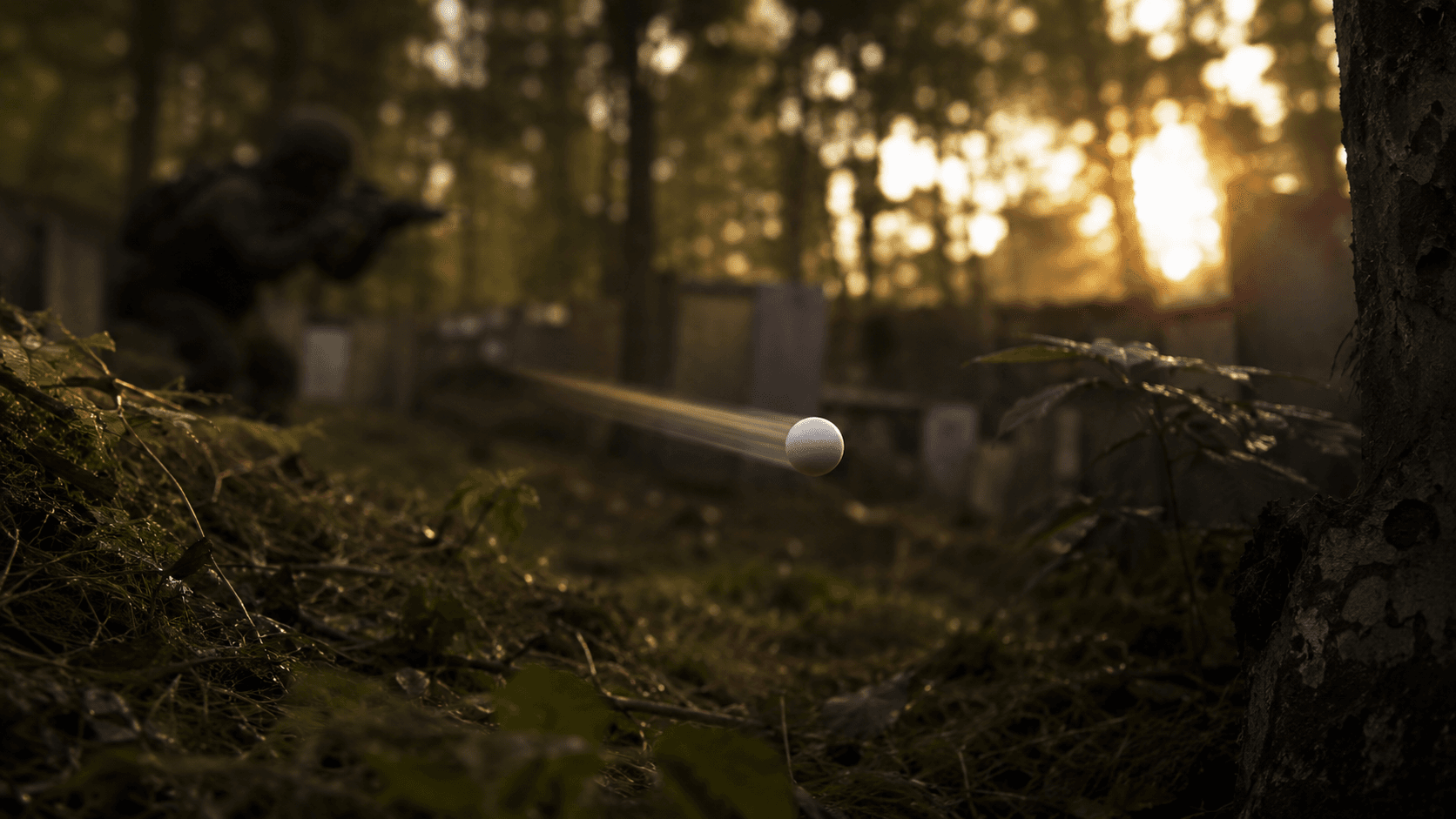
Two airsoft replicas can chrono at exactly the same joules and shoot completely differently downrange — one flat and tight to 45 meters, the other dropping into the dirt at 25. Range is not one number. It is the result of a small physics fight that happens on every single shot. Here is that fight, in plain language.
The three forces on a flying BB
The moment the BB leaves the barrel, the gun is done with it. From there, only three things act on that little plastic sphere:
- Gravity — a constant downward pull of about
9.81 m/s². It pulls every BB down at the same rate, light or heavy. - Air drag — friction with the air. It always opposes motion and grows with the square of speed, so it is brutal at the muzzle and gentler as the BB slows down.
- Hop-up lift — the backspin from your hop-up makes the BB push itself upward, fighting gravity. Without it, the BB just falls.
Everything else in this article — energy, BB weight, hop tuning, BB quality — is just a way of influencing how those three forces play out. Range is the story they tell together.
Where the joules come from
Inside the gun, a spring (in an AEG) or compressed gas (in a GBB or HPA) pushes the BB down the barrel. That push is work, and work becomes kinetic energy — measured in joules. The formula is the same one from every physics class:
Here is the catch that trips up most players: energy is set at the muzzle, and only at the muzzle. It tells you how hard the BB launches. It tells you nothing, on its own, about where the BB lands. Two guns at 1 J can put a BB in wildly different places — because weight, hop and BB quality take over the instant the BB leaves the barrel.
Why BB weight changes everything
Start from the energy formula. Energy at the muzzle is roughly fixed, so if you put a heavier BB (m goes up), velocity (v) has to come down. Heavier BBs are slower. So far that sounds bad for range — but it is the opposite, and here is why.
1. Heavier BBs keep their speed. Drag is a force, and a force slows a heavy object less than a light one (acceleration = force ÷ mass). The same air resistance barely dents a 0.40 g BB but hammers a 0.20 g one. The heavy BB launches slower, then holds that speed far longer.
2. Heavier BBs ignore the wind. More mass means more inertia — more resistance to being pushed sideways. A 0.20 g BB drifts noticeably in a light breeze; a 0.36 g or 0.40 g BB barely notices it. Outdoors, this is often the single biggest accuracy difference.
3. Heavier BBs spin more stably. They carry hop-up backspin in a steadier, more predictable way, which keeps the trajectory clean.
The trade-off: a heavier BB is slower, so it needs morehop-up lift to stay flat. If your hop cannot lift it, it drops early. There is a sweet spot — for most AEGs around 0.28–0.36 g, heavier for DMRs and snipers — where the BB is heavy enough to fly true but light enough for your hop to carry it.
Hop-up: the spin that fights gravity
Take hop-up out of the equation and a BB does exactly what any thrown ball does: it falls. A few meters out, it is already on the ground. Hop-up is what turns that into a flat 40-meter shot.
The hop-up unit presses a small rubber bump against the top of the BB as it passes, giving it backspin — the top of the BB spinning backward, toward you. A spinning ball moving through air generates lift. This is the Magnus effect, the same physics that curves a free kick in football or makes a topspin tennis ball dive.
Backspin makes the BB throw air downward, so the air pushes the BB upward. Tune it correctly and that upward lift almost perfectly cancels gravity. The BB stops falling and flies nearly flat — for a long stretch — before the lift finally fades and it drops.
This is why hop-up is, dollar for dollar, the single biggest range upgrade on any gun. A well-tuned hop can roughly double the effective range of the exact same replica — no extra power, no new spring, just spin used well.
Drag, and why a quality BB matters
Drag is air resistance. It grows with the square of speed, and it also depends on the BB’s shape and surface. This is where “buy good BBs” stops being marketing and becomes pure physics:
- Roundness. A BB that is not perfectly spherical wobbles in flight and drags unevenly — the trajectory curves in ways you never aimed for.
- Diameter consistency. A BB slightly too large jams the hop-up; one slightly too small lets air leak past it in the barrel, losing both energy and spin.
- Surface and seams. A visible mould seam or pitting from a cheap factory disturbs the airflow around the BB and steers the shot unpredictably.
There is a neat twist here. The backspin does not only create lift — it also lowers drag. A smooth spinning sphere trips its own thin layer of air into a turbulent state that clings to the surface longer, which delays the airflow from separating and shrinks the drag wake. It is the same reason a golf ball has dimples. But that benefit only shows up if the BB is consistent enough to spin true in the first place.
What actually sets your effective range
Effective range is the distance at which the BB still flies flat enough and straight enoughto hit a torso-sized target on purpose — not by luck. It is never one component. It is the combination of:
- Energy — sets the launch speed and the ceiling.
- BB weight — decides how well that speed survives and how much wind moves it.
- Hop-up — decides how long the BB stays flat instead of dropping.
- BB quality — decides whether it flies the line you aimed.
- Air seal and barrel — decide how cleanly energy and spin are delivered in the first place.
Change any one and the others shift. That is why an honest range tool returns a band, not a single number — and why a trajectory chart will show the BB still arriving on target while its energy has quietly dropped to a fraction of what it left the muzzle with. The BB is being carried by spin, not by power.
The role of each part, ranked
If your goal is range and accuracy, here is what each piece actually does — and roughly the order to spend money in:
- Hop-up unit, bucking and nub — the number-one range and accuracy upgrade. Cheap, and the effect is enormous. Tune it before anything else.
- BB weight and quality — second. Match the weight to your power, and never run inconsistent BBs. This is upgrade money you spend every game.
- Spring / power (energy) — sets the ceiling, but more power with a bad hop just gives you a faster miss. It is also capped by every field, so it is not a free lever.
- Air seal — cylinder, nozzle and bucking. Leaks waste energy and spin before the BB even leaves. Unglamorous, but it underpins everything above.
- Inner barrel — consistency and a clean bore matter far more than raw length. A good seal beats a long barrel.
The takeaway: power buys you a ceiling, but hop-up and good BBs buy you the range. Spend your time and money there first — the physics is firmly on your side.
Coordinate your next game with Tattica Six
Live GPS map, push-to-talk and shared briefing — for the squad that takes airsoft seriously.
Explore Tattica Six